
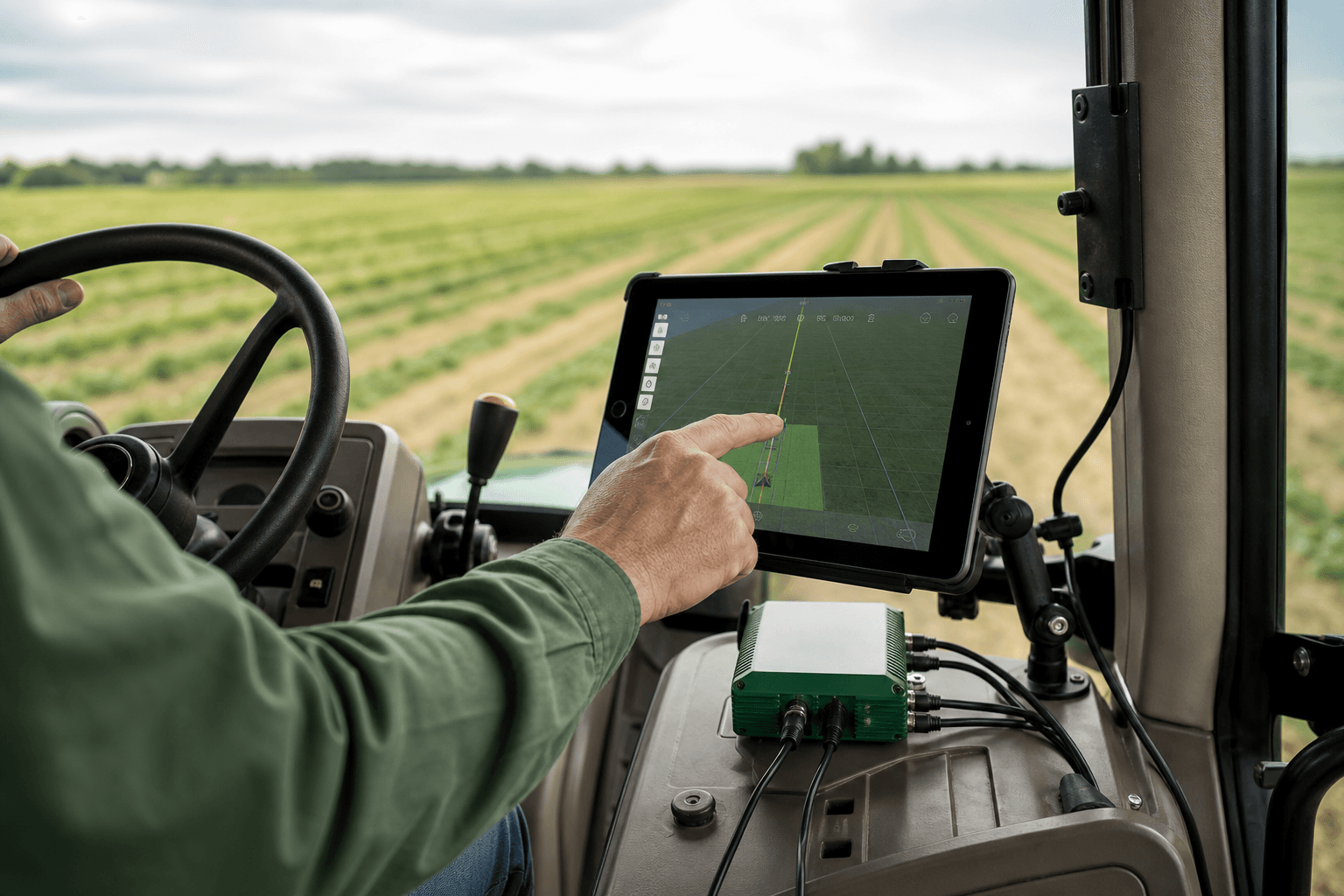
Tractor GPS Explained: How Modern Guidance Systems Transform Farming
What Tractor GPS Actually Controls (And the Self-Driving Myth)
You have been hand-steering a 12-hour day in a tractor that could have been driving itself since 2013. If your machine left the factory with hydraulic or electronic steering accepting CAN-bus commands — most John Deere R-series, Case IH Magnum, New Holland T7+, Fendt 700-series, and Massey 7700+ from roughly 2013 onward — the steering ECU is already waiting for a guidance signal. The question is not whether tractor GPS belongs on your machine. It is which architecture fits your operation: free GPS at about 2 m accuracy (useless for autosteer), sub-meter for spraying, or RTK at 1–2 cm for repeatable planting and strip-till.
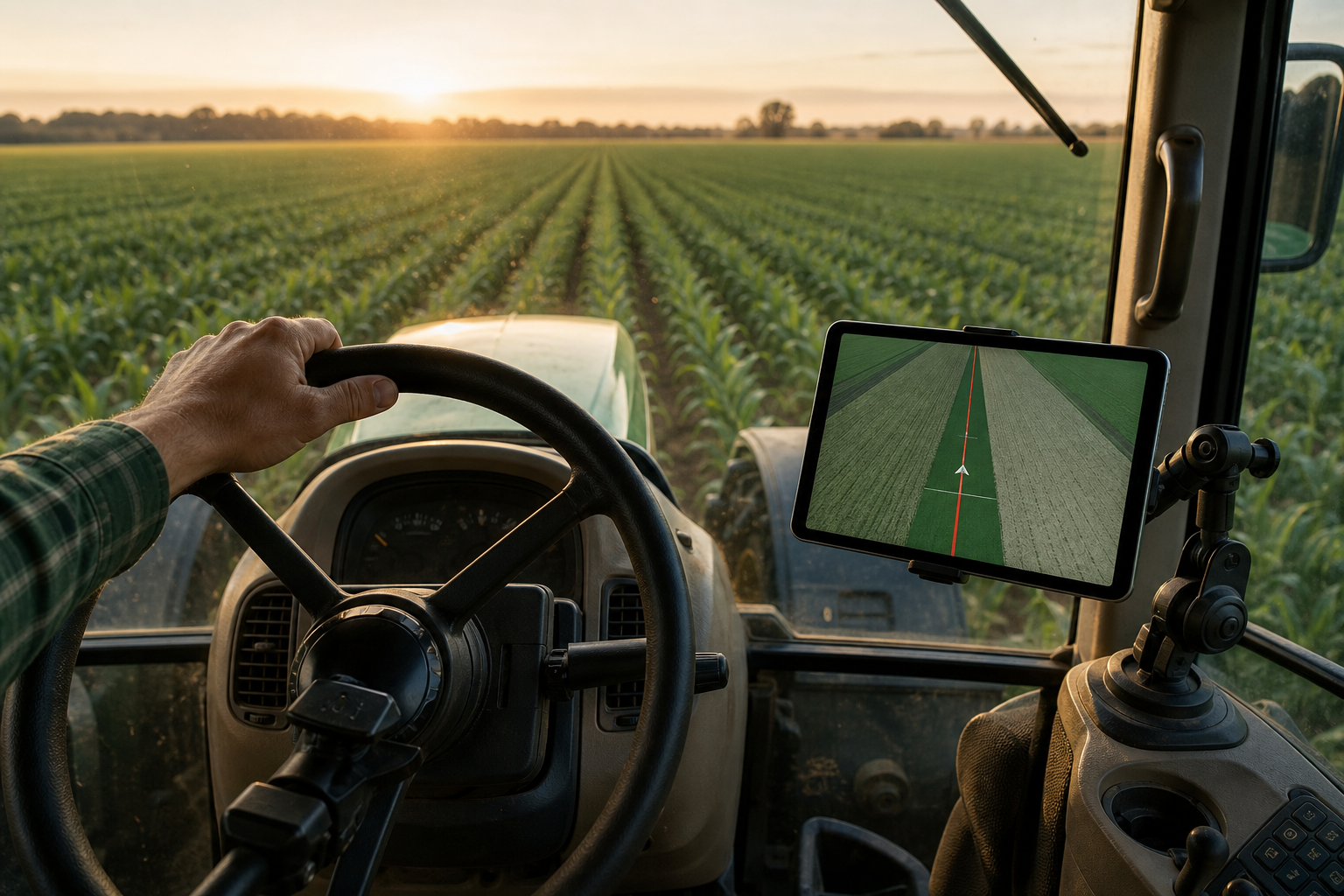
Table of Contents
- What Tractor GPS Actually Controls (And the Self-Driving Myth)
- Matching Accuracy to the Job — A Task-by-Task Decision Matrix
- The RTK Signal Chain — From Satellite to Steering Wheel
- Proprietary vs. Open-Platform — The Architecture Decision
- Hardware Fit Check — Is Your Tractor Actually Ready?
- Accuracy Reality — What RTK Delivers vs. What Goes Wrong
- Total Cost of Ownership Over Five Years
- Pre-Purchase Checklist and Operation-Size Decision Tiers
What Tractor GPS Actually Controls (And the Self-Driving Myth)
Before comparing prices or vendors, fix the mental model. Tractor GPS is not one product — it is a stack of three accuracy tiers, each matched to specific field tasks. Buying the wrong tier wastes money in two directions: overspending on RTK for a manure spreader, or under-buying sub-meter for a planter.
Tier one — standalone GPS. Raw GNSS signals deliver 1–3 m horizontal accuracy (RTKdata). A practical farmer-facing video pegs free GPS at around 2 m. This is adequate for field boundary mapping, coverage tracking, or first-pass tillage where implement width hides drift. It is useless for autosteer. At 2 m of jitter, the tractor weaves visibly within the cab.
Tier two — sub-meter with SBAS or paid corrections. Accuracy tightens to around 30 cm, which is the recommended floor for spraying and fertilizing where boom overlap drives chemical waste. A 24 m boom can absorb 30 cm of cross-track error; a 6 m boom cannot.
Tier three — RTK at 1–2 cm. This is the threshold for precision planting, strip-till, and repeatable autosteer passes across seasons (RTKdata; ArduSimple). Below this accuracy, controlled-traffic farming and inter-row cultivation break down because year-to-year repeatability cannot be guaranteed.
Now the self-driving myth. Autosteer is not autonomy. The system controls steering angle only. Engine throttle, hydraulics, PTO, implement depth, and headland turns remain operator-controlled. You sit in the seat. You manage turns. You monitor the implement. You intervene for obstacles. What changes is that your hands come off the wheel during the working pass — which is where fatigue accumulates over a 12-hour day.
The technology is not new. According to NASA's Spinoff program, John Deere's AutoTrac — developed with NASA JPL correction technology — achieved roughly 4 inch (~10 cm) guidance accuracy more than a decade ago. High-precision tractor guidance is a mature control problem. What has changed since then is the cost structure and the openness of the hardware ecosystem.
The economic gains come from a specific place. Dr. Joe Luck, Associate Professor of Biological Systems Engineering at the University of Nebraska–Lincoln, has framed precision guidance value in extension publications as reduced overlap, reduced skips, lower operator fatigue, and input savings on seed, fertilizer, and chemical — not direct yield magic. Translation: a 6 m boom sprayer running with 10 cm of overlap on every pass across a 200-acre field wastes measurable chemical. RTK reduces that overlap to under 2 cm. The savings compound across every input pass for the life of the system.
Last, the vocabulary you need before reading anything else:
- GNSS — the umbrella for satellite positioning: GPS (US), GLONASS (Russia), Galileo (EU), BeiDou (China). Multi-constellation receivers lock more satellites under partial sky cover.
- RTK — Real-Time Kinematic. A correction technique that compares the rover's raw signal to a fixed reference, removing atmospheric and orbital errors.
- NTRIP — Networked Transport of RTCM via Internet Protocol. The cellular delivery method for RTK corrections.
- CAN bus — the in-vehicle network that lets a controller send steering commands directly to a steer-ready tractor's ECU.
- CORS — Continuously Operating Reference Stations. The public/commercial base station networks that NTRIP plans tap into.
With those terms in hand, the rest of the article assumes RTK as the target — because planting is the highest-value pass on most row-crop operations.
Matching Accuracy to the Job — A Task-by-Task Decision Matrix
Buying RTK for a manure spreader is overspending. Buying sub-meter for a planter is under-buying. The matrix below maps required accuracy to the operation that drives it.
| Operation | Required Accuracy | GPS Tier | Update Rate | Why |
|---|---|---|---|---|
| Field mapping / coverage | 1 m – sub-meter | Free GPS / SBAS | 5 Hz | Boundaries only; no overlap penalty |
| Primary tillage | Sub-meter | SBAS / paid | 5 Hz | Implement width tolerates drift |
| Spraying / fertilizing | ~30 cm | Sub-meter paid | 5–10 Hz | Boom overlap = chemical waste |
| Cultivation / row-crop | 2–5 cm | RTK | 10 Hz | Must track existing rows |
| Precision planting | ~2.5 cm | RTK | 10–20 Hz | Seed placement is permanent |
| Strip-till / controlled traffic | 1–2 cm (RTK FIX) | RTK | 10–20 Hz | Repeatable passes across seasons |
Accuracy figures sourced to FJDynamics and RTKdata.
The update rate column matters more than most buyers realize. FJDynamics states that 5 Hz is adequate for manual lightbar guidance, but autosteer requires ≥10 Hz for smooth tracking at field speed. Here is why: at 12 km/h, the tractor covers roughly 33 cm per 100 ms. At a 5 Hz update (200 ms), that's about 67 cm of travel between corrections — enough that the controller's steering commands lag behind reality. The operator perceives this as weaving on tight rows.
Oklahoma State University Extension cautions producers to match system accuracy to actual field operations rather than defaulting to the highest tier. The extension framing matters because vendor marketing pushes RTK on every buyer regardless of whether the operation justifies it.
Dr. Terry Griffin, an agricultural economist at Kansas State University, has noted in precision-ag economics work that small farms with limited operating hours often see slower payback on premium RTK subscriptions. For those operations, owning a local RTK base station or using a low-cost NTRIP feed makes more sense than committing to a vendor-locked annual correction plan. The hardware can deliver RTK accuracy; the question is whether the correction subscription model fits your hours and acres.
The rest of this guide assumes RTK because most row-crop operations have at least one operation — planting, strip-till, or controlled-traffic cultivation — that demands it. If your highest-precision pass is broadcast fertilizing, the same hardware still serves you; you simply use a cheaper correction source.
The RTK Signal Chain — From Satellite to Steering Wheel
Five components, end to end. If you understand each one, you can diagnose every failure mode in this article without calling a dealer.
Step 1 — GNSS satellites broadcast position signals. Multi-constellation receivers (GPS + GLONASS + Galileo + BeiDou) lock more satellites simultaneously, which improves accuracy under partial sky cover such as tree lines or near grain bins. Raw uncorrected position error sits at 1–3 m.
Step 2 — A reference station calculates the correction. This is either a private base station on your farm (a fixed antenna at a precisely surveyed point) or a CORS/NTRIP network. RTKdata reports access to over 20,000 permanent base stations across 145+ countries, with plans starting around US$40/month. The reference station knows its own position to millimeter precision; it measures the GPS error in real time and broadcasts a correction message.
Step 3 — The correction reaches the tractor. Two delivery methods:
- NTRIP over cellular. A modem in the cab streams RTCM correction data over 4G. This is why hardware variants with a built-in modem exist — they remove the dependency on a separate phone or hotspot.
- Radio link from a local base station. No internet required, but range-limited to roughly 10 km line-of-sight.
NTRIP stands for Networked Transport of RTCM via Internet Protocol — the cellular streaming standard for RTK corrections (RTKdata).
Step 4 — The receiver computes a FIX solution. RTK states progress through three levels: SINGLE → FLOAT → FIX. Only FIX delivers the 1–2 cm pass-to-pass accuracy the spec sheet promises. FLOAT (10–50 cm) is a warning state; SINGLE means corrections are not arriving and you are back to raw GPS at 1–3 m. The UI on any decent guidance app shows these states explicitly.
Step 5 — The controller closes the steering loop. The autosteer controller calculates cross-track error (the perpendicular distance from the planned line to the current position), sends a steering command over CAN bus on a steer-ready tractor, or drives an electric steering wheel motor on a retrofitted machine. It does this at 10–20 Hz — fast enough that tractor inertia smooths the discrete corrections into a continuous line.

The signal chain is not magic. It is five linked components, and each one can be sourced from an open ecosystem instead of a single vendor.
If any step breaks — cellular drops, antenna goes obstructed, correction stream times out — the system degrades to FLOAT or SINGLE. It does not crash the tractor. It warns the operator and reverts to a coarser guidance line. That graceful failure mode is what makes RTK practical for production work rather than a lab curiosity.
Proprietary vs. Open-Platform — The Architecture Decision
Proprietary systems work. Trimble, John Deere, Ag Leader, and others have decades of dealer support, integrated implement control, and a single phone number to call when something breaks. The strength is real. The cost is a stack of vendor-locked layers: their terminal, their receiver, their correction subscription, their update cycle.
Open-platform systems built on AgOpenGPS decouple those layers. You choose the receiver, the correction source, the display device, and the controller independently. That flexibility is the architectural argument.
| Criterion | Proprietary | AgOpenGPS Community Build | Agro Navigator |
|---|---|---|---|
| Display device | Vendor terminal | Windows PC / tablet | Native iOS (iPad / iPhone) |
| RTK receiver choice | Vendor only | Open (any u-blox / Septentrio) | Open (any compatible) |
| Correction source | Vendor subscription | Any NTRIP / local base | Any NTRIP / local base |
| CAN-bus integration | Yes (steer-ready) | Community board dependent | Yes (dedicated hardware) |
| Telemetry / fleet view | Premium tier | Manual / DIY | Built-in (4G variant) |
Architecture distinctions sourced from FJDynamics and Oklahoma State Extension.
Where proprietary still wins. Mature dealer networks, single-call support, and tight integration with the vendor's planters and sprayers. For a 5,000-acre operation already running one OEM's implements with shared displays, switching architectures costs more than it saves. Acknowledge it.
Where open-platform recovers cost. No annual software subscription. Choose any RTK receiver — a Septentrio Mosaic, an Ardusimple board, a community-built unit. The resale market on the AgOpenGPS forum is active because hardware transfers between farms without license keys.
Pure community AgOpenGPS builds carry a real friction cost: a Windows laptop in the cab, driver troubleshooting, and homemade controller boards that work but feel handmade. Agro Navigator's contribution to this ecosystem is a native iOS app paired with dedicated CAN-bus hardware — the iPad or iPhone already in the cab becomes the terminal, and the controller ships pre-integrated rather than as parts in a bag. The 4G modem variant adds fleet telemetry that DIY builds typically lack.
The vendor warning that "hardware is only as good as the support behind it" applies to both proprietary and open-platform buyers. The difference is whether support comes from a dealer with a margin to protect or from a manufacturer plus an open community. Competitors like agopen.shop, rtk-gps.nl, cereagps.com, and ontrak.ag all sell into the open-platform space, but none currently ships a native iOS application — the closest alternatives still require a Windows tablet or PC riding in the cab.
Hardware Fit Check — Is Your Tractor Actually Ready?
Before requesting any quote, self-assess. Six checks separate a clean install from a budget blowout.
Steer-Ready Verification. "Steer-ready" means the tractor has factory-integrated hydraulic or electronic steering accepting CAN-bus commands (FJDynamics). Verify via the dealer build sheet, the model documentation, or the presence of an ISO 11783 connector under the cab. Most John Deere R-series, Case IH Magnum, New Holland T7+, Fendt 700-series, and Massey 7700+ from roughly 2013 onward are steer-ready from the factory. Older or smaller models often are not.
Retrofit Path for Non-Steer-Ready Tractors. Older machines need an add-on electric steering wheel motor that bolts onto the column, or a hydraulic valve block plumbed into the steering circuit (FJDynamics). Add 4–8 hours of installation and the cost of the motor or valve. The CAN-bus advantage disappears here — both proprietary and open systems need the same retrofit hardware on a pre-2013 tractor. Even with autosteer reducing the steering-wheel grip on long days, sustained cab work still demands physical conditioning; see our guide on functional strength for farmers for what offsets long seat-time.
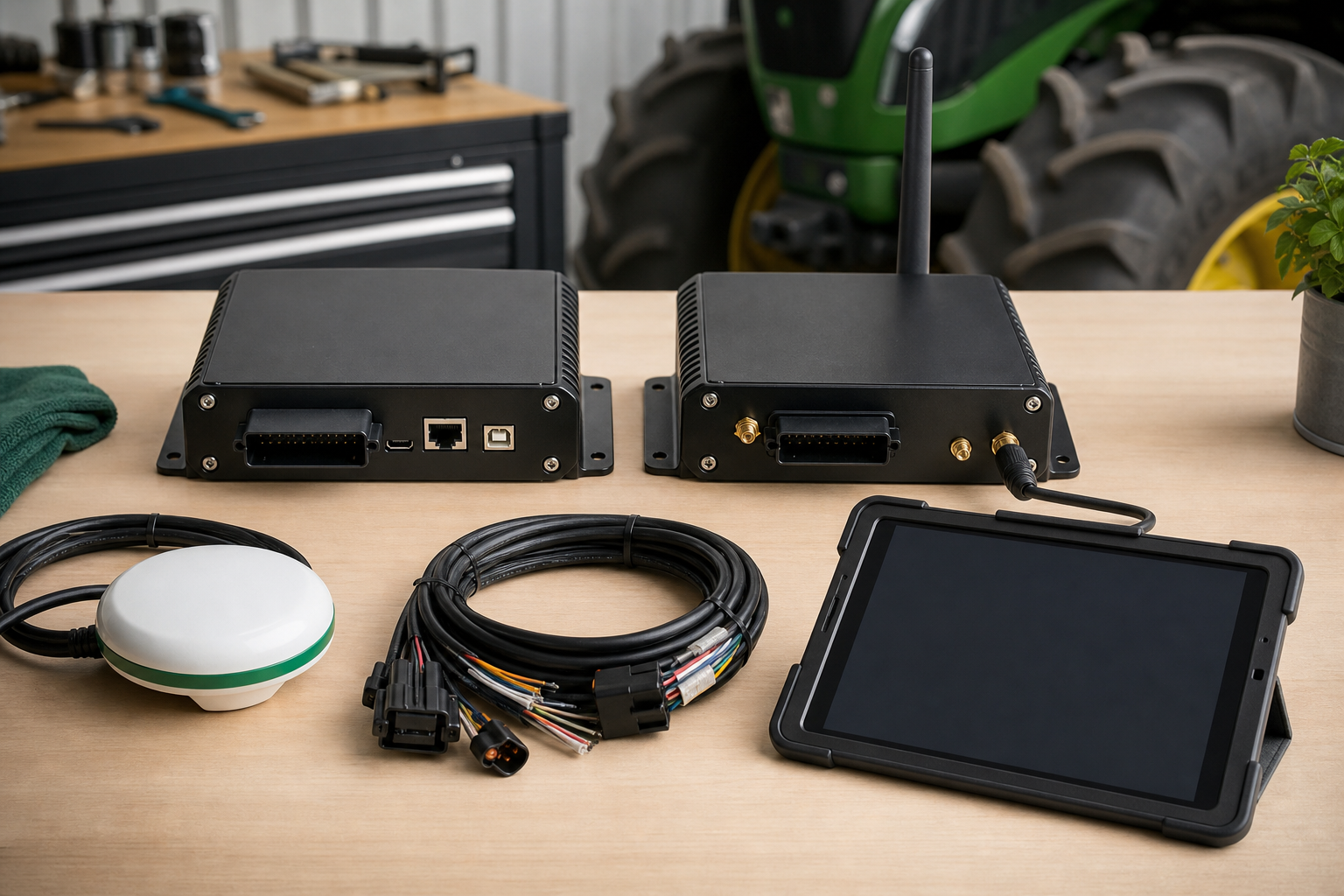
RTK Antenna Placement. Mount the antenna at the highest point of the cab with unobstructed sky view — typically the cab roof centerline above the operator. Avoid the exhaust stack (vibration and heat degrade signal stability). Run the cable under the headliner to the controller. ArduSimple notes that a complete kit can be installed "in a couple of hours" — realistic for self-installs by competent operators. Dealer-led CAN-bus integrations on steer-ready tractors run 2–6 hours.
Controller & Power. The controller draws from the tractor's 12 V system — negligible load compared with cab lighting. A wired model connects to the iPad via Ethernet-over-USB for deterministic low-latency communication. A 4G modem variant adds an internal SIM for NTRIP corrections and telemetry uplink, which matters when the farm spans cellular dead zones and you need to switch between correction sources mid-field without dragging a phone out of the holster.
iOS Device Choice. Any current iPad with a Lightning or USB-C port running a recent iPadOS works. iPhone is supported for compact installations or smaller machines. The reason iOS-native matters operationally: no Windows PC to boot, no driver hell, no antivirus license, no Bluetooth pairing roulette every cold morning. The device the farmer already owns becomes the terminal — which eliminates a roughly $1,500 rugged Windows tablet from the budget.
Cellular Coverage Reality Check. If using NTRIP corrections rather than a local base station, confirm 4G coverage at the field edges, not just the farmhouse. Drive the perimeter with a signal meter or a phone showing dBm readings. Where coverage is weak, plan for a local RTK base station — one-time cost, no monthly fee, roughly 10 km radio range from the antenna location.
Accuracy Reality — What RTK Delivers vs. What Goes Wrong
Spec sheets quote pass-to-pass accuracy. Field experience is more nuanced.
What 1–2 cm actually means. Pass-to-pass accuracy describes how close two consecutive parallel passes track to each other within the same RTK session. Year-to-year repeatability — the metric that controlled-traffic and strip-till operations care about — is closer to 2–3 cm because base station drift and atmospheric variation compound across seasons. Dr. Ajay Sharda, Associate Professor of Biological and Agricultural Engineering at Kansas State University, has stressed in field demonstrations that 2–3 cm pass-to-pass is the practical autosteer benchmark, with the additional requirement that controller update rate stay at 10 Hz or higher for smooth steering at speed.
When RTK degrades. Honest list:
- Tree lines and buildings block sky view, drop satellite count, and degrade FIX to FLOAT.
- Severe weather — heavy precipitation and ionospheric storms — adds signal noise.
- Cellular dead zones drop NTRIP corrections; the system reverts to SINGLE GPS at 1–3 m.
- Radio interference near high-voltage lines or large metal structures can disrupt local base station links.
FieldBee and TractorStore both note that these environmental factors are inherent to GNSS physics — they affect every brand and platform equally. No vendor immunity.
Failure modes are graceful, not catastrophic. When RTK drops, the system reverts to FLOAT or SINGLE — guidance accuracy degrades, but steering does not stop. The operator gets a clear UI warning. Compass and IMU fallback maintain heading during brief satellite gaps of a few seconds. This is true for proprietary and open-platform systems alike because the underlying physics is identical.
RTK GPS fails gracefully. You get a FLOAT warning and a compass-backed steering line — not a dead tractor in the middle of a field.
Latency perception. A 10 Hz controller updates every 100 ms; at 12 km/h field speed, that is roughly 33 cm of travel between updates. Operators do not perceive this as lag because tractor inertia smooths the discrete corrections. A 5 Hz controller (200 ms, ~67 cm per update) is where weaving becomes visible on tight row-crop work.
Operating conditions you can ignore. Soil type does not affect GPS position. Dew, light rain, and dust are fine. Night operation is identical to day — satellites do not care about ambient light. What matters is the controller's rated operating temperature; confirm the unit is specified for the cab environment, with -20°C to +60°C being typical for production ag hardware.
Maintenance reality. Annual checks involve antenna cable connectors, mounting bolt torque, and controller dust intrusion. iOS app updates ship through the App Store on the operator's schedule — no Windows update cycles ambushing you on a planting morning. Firmware updates on the controller arrive over-the-air on the modem variant and via USB on the wired model.
Total Cost of Ownership Over Five Years
Dollar figures for proprietary terminals vary widely by region and dealer, so the table below uses qualitative tiers rather than fabricated point estimates. The directional comparison is what matters.
| Cost Line | Proprietary | AgOpenGPS DIY | Agro Navigator |
|---|---|---|---|
| Hardware upfront | High (vendor terminal + receiver) | Low (community board + receiver) | Moderate (dedicated hardware) |
| Display device | Included (proprietary) | Windows tablet/PC required | Existing iPad / iPhone |
| RTK corrections (annual) | Vendor subscription | Open NTRIP from ~US$40/mo | Open NTRIP from ~US$40/mo |
| Installation labor | 4–8 hrs dealer | ~2 hrs self-install | 2–6 hrs CAN-bus |
| Software updates | Vendor-controlled | Free (community) | Free via App Store |
| Vendor lock-in | High | None | None |
RTK subscription floor from RTKdata. Installation time ranges from ArduSimple and FJDynamics.
Where open-platform recovers cost fastest. Two line items dominate: elimination of the vendor RTK subscription premium (dropping to roughly US$40/month NTRIP) and reuse of the operator's existing iPad. For a 500-acre row-crop operation, those two reductions alone often justify the system within roughly 2–3 seasons through reduced overlap on planting and spraying. The hardware payback then continues for the remaining life of the controller.
Where proprietary still makes financial sense. Large operations with existing vendor implements sharing the same display, or operations where 24/7 dealer service uptime during planting is mission-critical. If you have one phone number to call and a dealer truck that arrives in two hours, that has real economic value during a tight planting window.
Dr. Terry Griffin's economic framing applies here: payback depends on operating hours and input costs. A small farm with under 500 seat-hours per year should be skeptical of premium subscriptions and prioritize transferable hardware. A 3,000-hour custom operator across a 5,000-acre operation amortizes any architecture quickly — the question becomes flexibility and lock-in rather than cost.
Resale logic. Open-platform hardware retains value on the AgOpenGPS community marketplace because any farmer with a steer-ready tractor can absorb it. Proprietary terminals tied to a specific OEM ecosystem have narrower buyer pools and lose value faster as that OEM releases new generations.
Fleet economics. A 4G modem variant amortizes across multiple tractors — one online dashboard tracks the entire fleet, which eliminates the per-machine telemetry subscription that proprietary systems typically charge. For an operation running three or more machines, this is where the open-platform math turns decisive.
Open-platform RTK cuts five-year total cost of ownership roughly in half — but only if you are willing to own your data and skip the annual vendor upsells.
Pre-Purchase Checklist and Operation-Size Decision Tiers
The reader exit ramp. Print this. Walk to the tractor.
- Confirm steer-ready status. Pull the dealer build sheet or have a technician verify CAN-bus steering support. If the tractor is not steer-ready, budget for an electric steering wheel motor or hydraulic valve retrofit and roughly 4–8 hours of installation.
- Calculate operating hours per season. Multiply average daily seat time by working days. Under 300 hours/year → prioritize low subscription cost and transferable hardware. Over 800 hours/year → autosteer fatigue reduction and overlap savings pay for any architecture fastest.
- Identify your highest-precision operation. If you plant or strip-till, RTK is mandatory. If your most demanding pass is broadcast spraying, sub-meter may suffice — but RTK hardware also handles sub-meter, so the only cost delta is the correction subscription. This logic applies equally to small-footprint and intensive growing operations, where every wasted centimeter of overlap compounds against tight margins.
- Locate an NTRIP correction source. Check national CORS networks first; commercial NTRIP plans start around US$40/month. If coverage is weak in your region, price a local base station — one-time cost beats ongoing fees over 5 years.
- Verify cellular coverage at field edges. Not the farmhouse. Drive the perimeter with a signal meter or a phone reading dBm. Weak coverage means a local base station; strong coverage means NTRIP works.
- Inventory your iOS devices. Any current iPad or iPhone eliminates the need for a Windows tablet in the cab. Confirm the port type (Lightning vs. USB-C) for cable compatibility before ordering.
- Request two installation quotes. Expect 2–6 hours of labor on a steer-ready tractor per FJDynamics installation guidance. Wide variance between quotes signals dealer markup rather than technical difficulty.
- Validate with the AgOpenGPS community. Post your tractor model, intended operations, and budget on the AgOpenGPS forum. Peer farms running the same model will confirm hardware compatibility before you spend a dollar.
Decision Tiers by Operation Size
Under 500 acres / hobby-to-small commercial. AgOpenGPS open hardware plus a local RTK base station. Lowest cash outlay, longest setup learning curve. Best fit for operators willing to absorb DIY friction in exchange for the lowest possible TCO.
500–2,000 acres / mid-size commercial. Dedicated open-platform hardware with a native iOS app and a shared NTRIP subscription. Best balance of cost, support, and workflow with no vendor lock-in. This is the segment where the value of a pre-integrated CAN-bus controller plus an iPad terminal is most defensible against both proprietary terminals and pure DIY builds.
Multi-tractor fleet / contractor operation. 4G modem variant with an online dashboard. Telemetry across the fleet, remote diagnostics, and per-machine performance visibility justify the modem upgrade. The same logic extends to operations farming sloped or terraced fields, where RTK guidance value scales with field complexity and the cost of overlap or skip rises sharply.
The concrete next step: request a tractor compatibility check at agronavigator.app with your model and steering configuration in hand. In parallel, scan AgOpenGPS forum threads for your specific tractor make to validate community experience before any quote is signed.