

Terrace Farming Examples From Around the World: Ancient Wisdom Meets Modern Yield
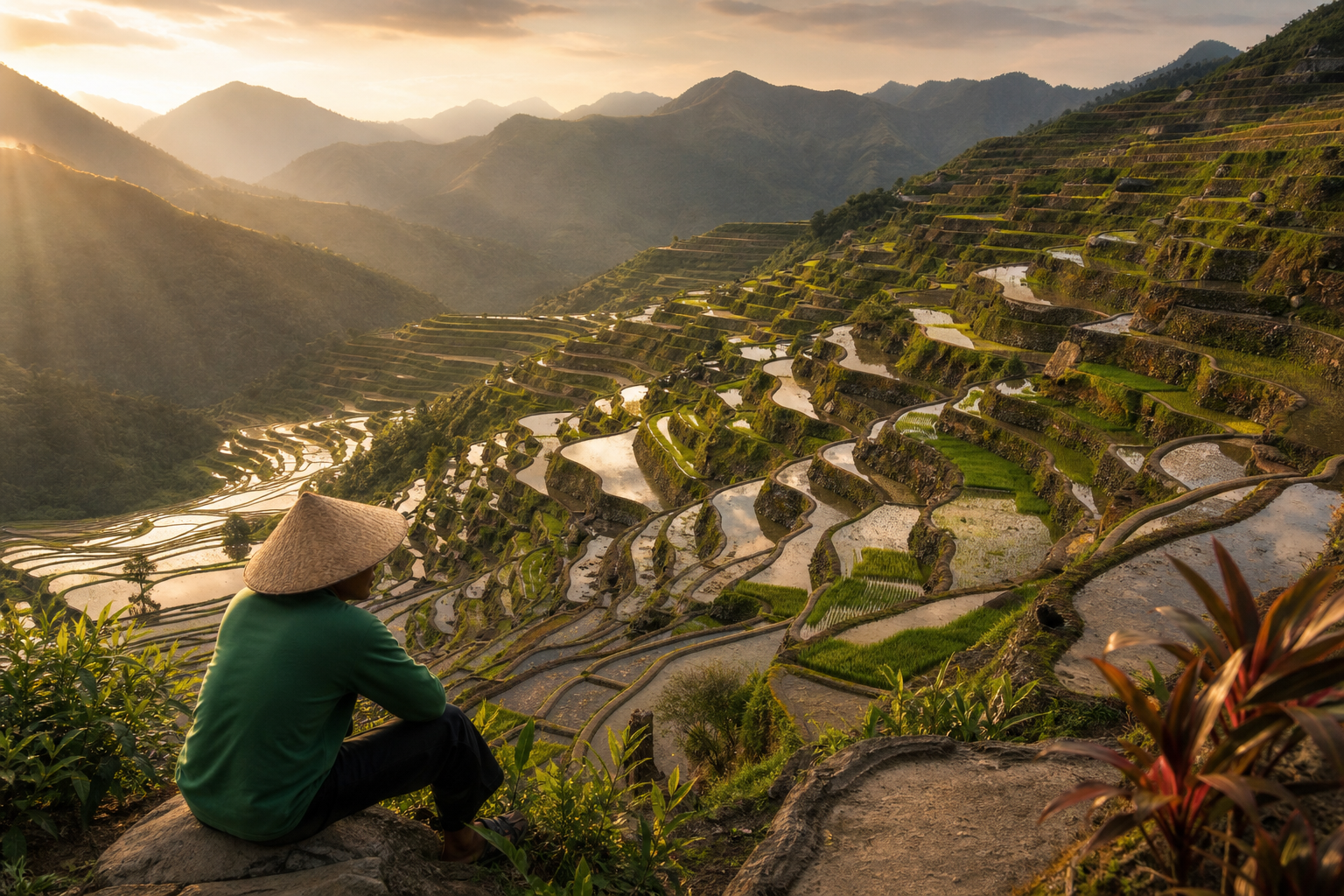
Your hillside sits unused while neighboring flat-land farms outproduce you. Heavy rain strips topsoil. Water runs off before roots can drink it. On non-terraced slopes, soil erosion runs 100–400 tons per hectare per year — versus just 5–15 tons on well-built terraces, according to the UNESCO Soil Erosion Assessment Report. Yet 2,000 years ago, farmers in the Philippines, Peru, and Italy solved this exact problem with hand tools and water logic. Their terraces still produce crops today.
What follows walks through six living terrace farming examples from four continents — what each system does, why it works, and how modern precision tools like RTK GPS autosteer reduce the labor cost that historically made terraces a multi-generational burden.
Table of Contents
- Why Sloped Land Punishes Conventional Row Farming
- Rice Terraces of Southeast Asia: Ifugao, Banaue, and Bali's Subak System
- Andean Potato Terraces: How Inca Engineers Beat Altitude, Frost, and Thin Soil
- Mediterranean Terraces: Stone Walls, Olives, and the Logic of Dry Farming
- Chinese and Japanese Terraces: Where Precision Geometry Was Invented
- Modern Terrace Revivals: Ethiopia, Rwanda, Spain, and the Carbon Economics
- Should You Terrace Your Slope? A Decision Framework with Precision-Agriculture Economics
- Terrace Farming: Four Questions Farmers Ask Most
Why Sloped Land Punishes Conventional Row Farming
Gravity does not negotiate. Every raindrop that hits a bare slope above 15° picks up kinetic energy proportional to the square of its surface velocity. By the time that water reaches the bottom of your field, it carries a measurable fraction of your topsoil with it. The numbers are not subtle: bare slopes shed 100–400 tons of soil per hectare per year, while engineered terraces hold losses to 5–15 tons per hectare (UNESCO). That is a 20-to-80x difference in soil loss from a single geometric intervention.
Infiltration time is the second collapse. Water needs contact time with soil to penetrate the root zone. On a 20° slope, sheet runoff moves at velocities that give water seconds — not minutes — to soak in. Dissolved nitrogen, potassium, and trace minerals leave the field with the water. Well-built terraces increase soil moisture retention by 25–35% in dry seasons and reduce runoff volume by 40–60% during heavy rain (UNESCO Water Security Report).
The terrace principle is mechanical, not mystical. A terrace converts vertical drop into a sequence of horizontal steps. Each step's surface slopes only 0.5–1% — and here is the engineering detail most modern earthworks contractors get wrong — that slope runs toward the upper retaining wall, not toward the open edge. This "inverse sloping" technique improved moisture capture efficiency by 22% in Chinese mountain farming systems (PMC peer-reviewed study). Water runs into the back of the terrace, where the soil column is deepest and the retaining wall provides a moisture reservoir for roots.
Terracing is not decoration. It is engineered hydrology — every centimeter of step height changes how water moves through soil.
Conventional row farming on a slope accelerates failure rather than mitigating it. Plowed furrows that run up-down the grade become channels that concentrate runoff, multiplying erosion compared to undisturbed land. Contour plowing helps — running furrows across the slope rather than down it — but on grades above 15° (26.8% grade), terracing is the only durable solution per USDA NRCS guidance. Below 10°, contour plowing alone usually beats the construction cost of terracing.
The economic translation is direct. Lost topsoil equals lost yield, and topsoil loss compounds: thinner soil retains less water, supports weaker roots, and shed more soil per storm. In Zimbabwe, no-till tied-ridging combined with maize residue mulch cut surface runoff by 50%, raised infiltration rates by 35%, and lifted grain yields by 20–25% (PMC) — and that is from a partial intervention, not full terracing.

What follows is not a museum tour. Each of the next five sections is a living terrace farming example — a different climate, a different crop, a different engineering answer to the same physics. For the broader benefits of terraced systems beyond erosion control, the structural logic carries across to carbon, biodiversity, and water security.
Rice Terraces of Southeast Asia: Ifugao, Banaue, and Bali's Subak System
The most photographed terrace farming examples on Earth are also the oldest continuously operated agricultural systems documented. The Ifugao terraces of the Philippine Cordillera mountains — carved by hand into 70-degree slopes more than 2,000 years ago — still feed the families that maintain them.
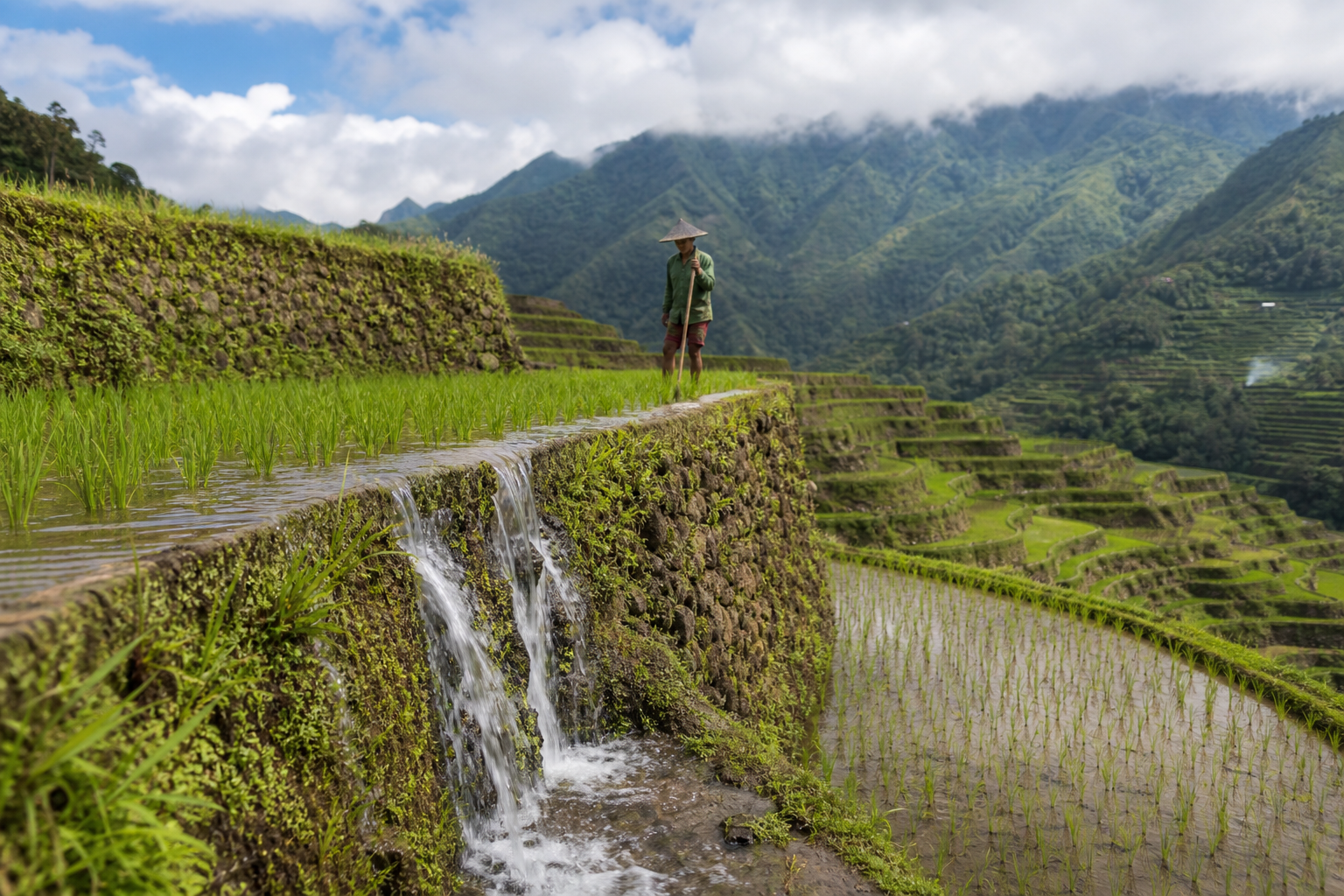
Ifugao geometry is purpose-built for monsoon hydrology. Vertical drops of 1–2 meters per terrace create individual paddies that flood deeply during the wet season. Water comes from upslope spring catchments and protected forest reserves that the Ifugao deliberately preserve as irrigation infrastructure. The forest is the water system. Overflow from each terrace cascades into the next downslope step — a passive, gravity-fed allocation that requires no pumps and no schedules. Modern yields hold at 3–5 tonnes per hectare of rice, comparable to mechanized lowland production (FAO Comparative Analysis).
Bali's Subak system, 1,000+ years old and UNESCO-recognized, solves the same monsoon problem with a different governance model. Where Ifugao uses cascading overflow, Subak uses controlled impoundment — each terrace holds water deliberately, released on a schedule set by a temple-based council that coordinates allocation across hundreds of hectares. Vertical drops are smaller (0.5–1.5 m), and many Subak terraces integrate duck-rice polyculture and secondary vegetable crops between rice cycles. Yields run 2–4 tonnes per hectare of rice plus the polyculture margin.
| Dimension | Ifugao (Philippines) | Bali (Indonesia) |
|---|---|---|
| Vertical drop per terrace | 1–2 m | 0.5–1.5 m |
| Water source | Upslope springs, forest catchment | Subak communal allocation |
| Water management | Cascading overflow | Controlled impoundment |
| Primary crop | Rice (single variety dominant) | Rice + secondary crops |
| Modern yield (tonnes/ha) | 3–5 | 2–4 |
Both systems share a design intent that modern engineers regularly miss: they exploit monsoon abundance rather than resist it. During heavy rain, terraces buffer water in stepped reservoirs instead of shedding it. During dry months, that stored upstream water releases gradually downslope. The principle generalizes far beyond rice: never let water move faster than soil can absorb it.
The cost is labor. Southeast Asian rice terrace maintenance consumes 15–20% of annual farming labor (PMC) — the highest of any terrace system documented. Water channels silt up. Earthen walls slump after typhoons. Rats burrow through retaining structures and create hidden leaks that empty a paddy overnight. This is why the same families maintain the same terraces for forty generations: the institutional knowledge of where the system has historically failed is the real asset.
On modern rice terrace rebuilds in Vietnam and northern Thailand, precision RTK autosteer is being deployed to align new terrace edges within <5 cm vertical tolerance — the same precision traditional builders achieved through ritualized water-level measurement (PNAS). The geometry is identical. The labor multiplier is not.
Andean Potato Terraces: How Inca Engineers Beat Altitude, Frost, and Thin Soil
At 2,500–4,000 meters above sea level, terracing solves problems beyond erosion. The Andean systems built by pre-Inca and Inca engineers — and still cultivated today in Peru, Bolivia, and Ecuador — represent the most aggressive environmental engineering in pre-industrial agriculture.
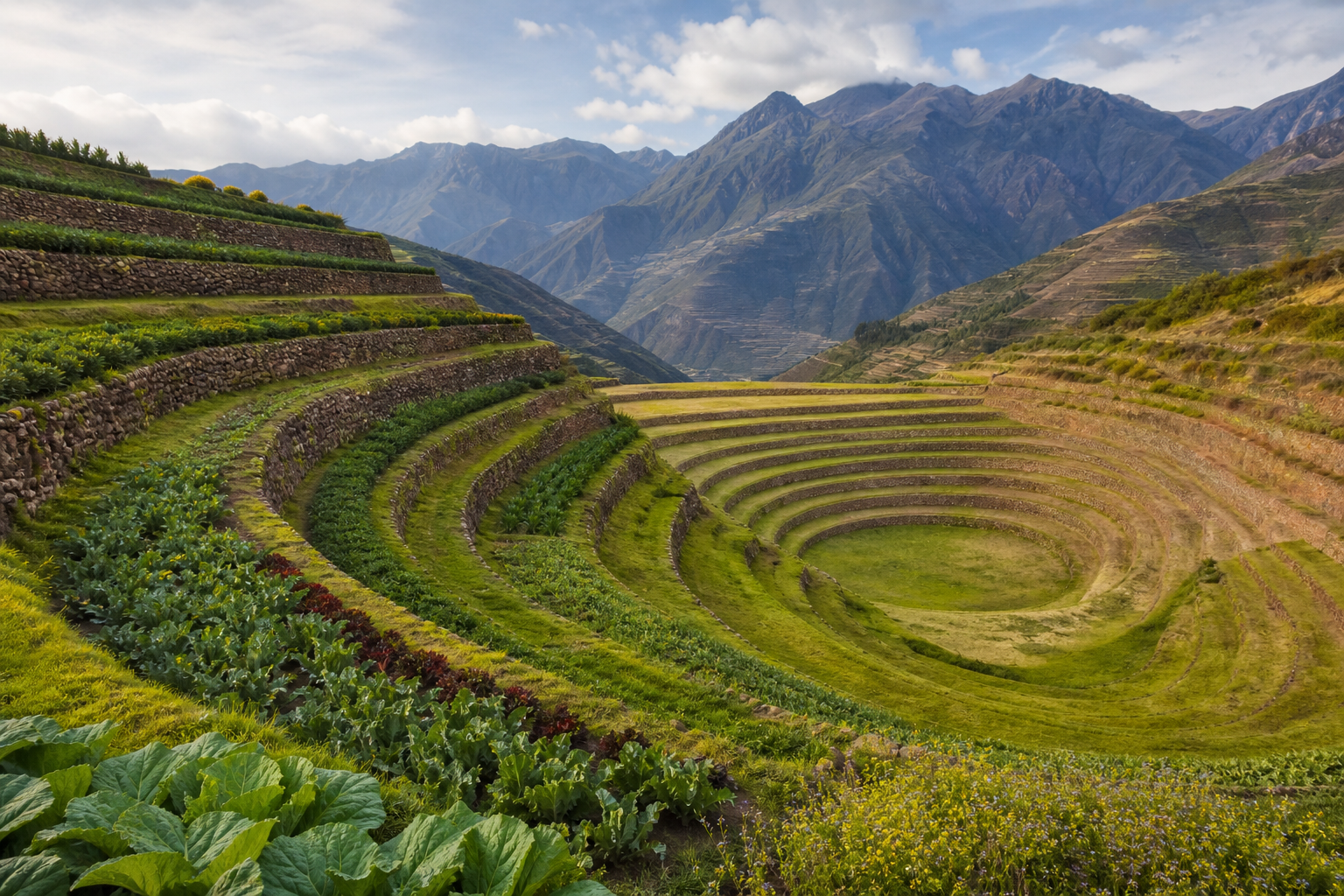
1. Wider terrace steps (2–4 meters). Andean terraces are markedly wider than Asian rice terraces. The reason is thermal, not hydrological. Wider steps allow daytime solar gain to warm the soil mass, which then releases heat overnight and buffers root zones against frost. At altitude, a 1–2°C overnight differential is the difference between harvest and total loss.
2. Multi-layer constructed soil. Andean terraces are not natural slope — they are manufactured root zones. Inca engineers layered gravel (drainage), coarse sand, fine soil, and topsoil over bedrock in deliberate sequence. The technique is documented archaeologically at Moray and Pisac. This is built fertility, accumulated and protected across generations.
3. Microclimate stacking. Dr. Martha Casanova of CIAT documented over 150 potato varieties grown across a single Andean mountainside by exploiting the temperature gradient between terrace levels: "Each terrace level creates a temperature differential of 1-2°C, allowing farmers to grow 150+ potato varieties across a single mountainside" (CIAT Research Bulletin). Each variety matches a specific elevation band's frost risk, water availability, and solar exposure.
4. Polyculture, never monoculture. Andean terraces rotate potatoes, quinoa, oca, ulluco, and beans across beds. A frost event or pest outbreak in any one season wipes out part of the harvest, never all of it. The polyculture is risk management dressed as agronomy.
5. Lower maintenance labor (10–15% of annual farming time). Because Andean terraces are dry-farmed or rain-fed rather than flooded, water channels need less continual upkeep than Southeast Asian wet rice systems (PMC). Stone-faced earthen walls last centuries with periodic repair rather than seasonal rebuild.
6. Modern reality — and the abandonment threat. Andean systems are 500+ years old and community-maintained. But rural depopulation now threatens continuity. In some valleys, terraces are abandoned at 2–3% annually, with younger generations migrating to cities. Precision agriculture on Andean slopes is harder than on lowland fields because of altitude-induced GNSS multipath from surrounding mountain walls, but properly sited RTK base stations have demonstrated <2 cm accuracy in Peruvian terrace rebuilds — sufficient for both repair and new construction.
Mediterranean Terraces: Stone Walls, Olives, and the Logic of Dry Farming
Move from monsoon Asia and altitude America to the dry-summer Mediterranean and the entire terrace logic inverts. With 40–60% less annual rainfall than Southeast Asia, the engineering problem is no longer how to manage abundant water — it is how to trap what little falls and keep it in the root zone for as long as possible.
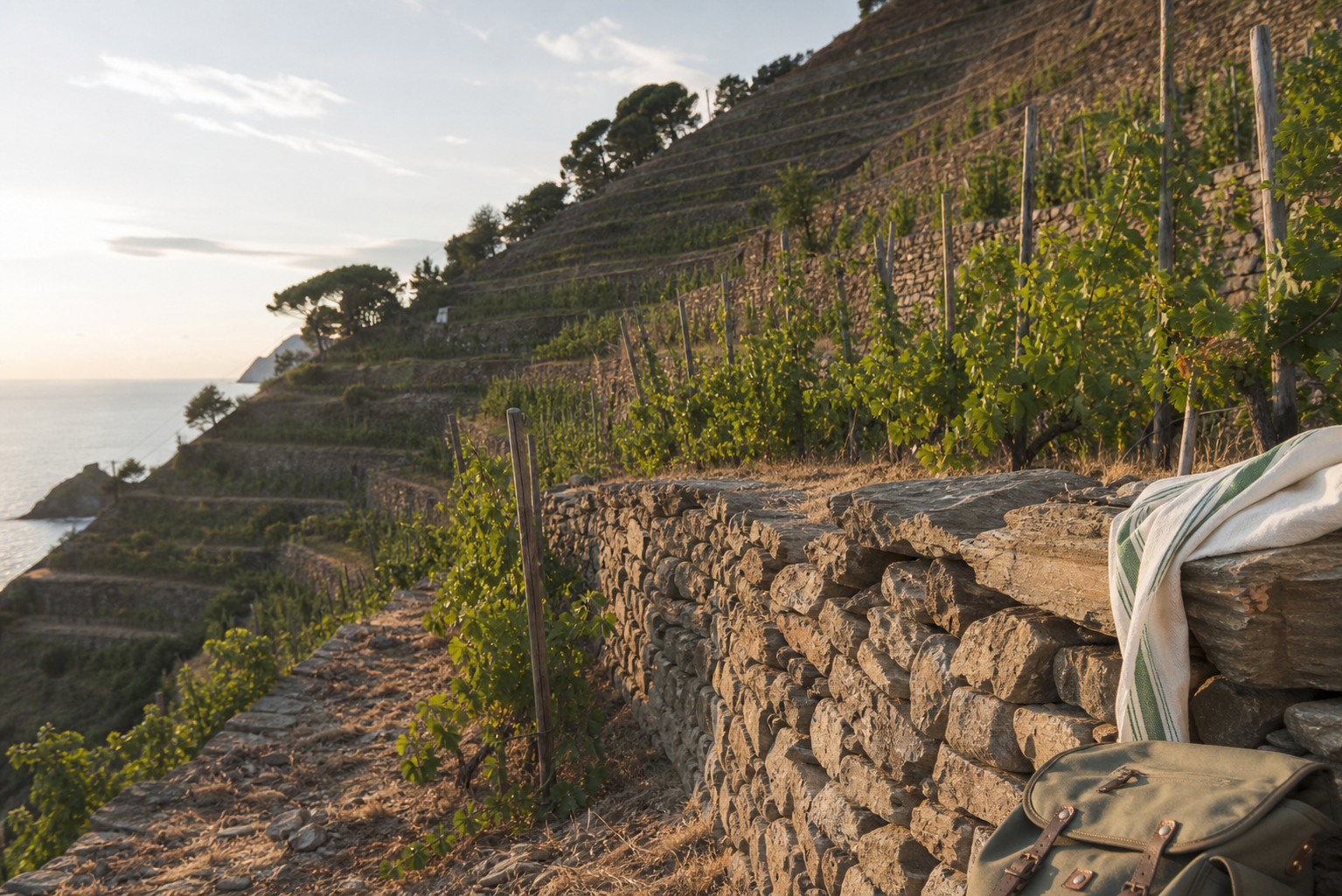
The Cinque Terre of Italy, the olive groves of Tuscany and the Peloponnese, and the citrus terraces of Mallorca all solve this with one shared technology: the dry-stone retaining wall. No mortar. No concrete. Just fitted stones engineered to last 400+ years. Gaps between stones allow controlled drainage that prevents catastrophic wall failure during occasional heavy rain, while soil packed behind the wall holds moisture against the long dry summer. Cinque Terre's terrace walls collectively stretch more than 6,700 kilometers — longer than the Great Wall of China, built and maintained by farmers, not empires.
Tree crops change the geometry. Olives, grapes, and citrus need wider terraces (3–6 meters) and deeper soil profiles to accommodate tap roots that reach 2–4 meters down. Yields run 1.5–2.5 tonnes per hectare of olives — lower in absolute mass than rice, but produced with 40–60% less water (FAO Comparative Analysis), and selling at premium prices that pay for the construction.
Maintenance labor drops sharply versus wet-rice systems — 5–10% of annual farming time (PMC). Stone walls need periodic repointing rather than constant water channel work. Pruning, harvest, and pest management dominate the labor calendar instead.
Here is the counter-intuitive finding most farmers considering abandonment never hear: when Mediterranean terraces are abandoned, erosion rises 25–30% above what conventional slope farming would produce, because collapsing stone walls create artificial gullies that concentrate runoff worse than the original natural slope (European Commission JRC Report). Abandonment is worse than never building. Once you commit to terraces, the long-term obligation is structural, not optional.
The four-region comparison below consolidates the engineering logic.
| Dimension | SE Asian (Rice) | Andean (Tubers) | Mediterranean | East Asian (Rice) |
|---|---|---|---|---|
| Water model | Monsoon abundance | Seasonal, altitude | Dry summers | Monsoon + dry winter |
| Primary crop | Rice (annual) | Potato/quinoa | Olive/grape | Rice (annual) |
| Terrace width | 1–2 m | 2–4 m | 3–6 m | 1–3 m |
| Wall construction | Earth, packed | Earth + stone facing | Dry stone | Earth + stone facing |
| Annual labor | 15–20% | 10–15% | 5–10% | 10–15% |
The pattern is consistent: drier climates demand sturdier walls and wider terraces, but reward those investments with lower ongoing labor. Wetter climates need less wall engineering but more continuous water-channel maintenance. There is no free terrace — each system trades construction cost against maintenance cost, and the trade is set by climate.
Chinese and Japanese Terraces: Where Precision Geometry Was Invented
East Asian terrace systems are where the engineering becomes mathematically explicit. The Yuanyang rice terraces of Yunnan, China — carved by the Hani people over 1,300+ years — cover more than 17,000 hectares across slopes averaging 25°. The Hani built a four-zone vertical system: forest at the top (water source and watershed protection), village below the forest, terraces below the village, river at the bottom. The forest is the irrigation infrastructure. Cut the forest and the system collapses within a decade.
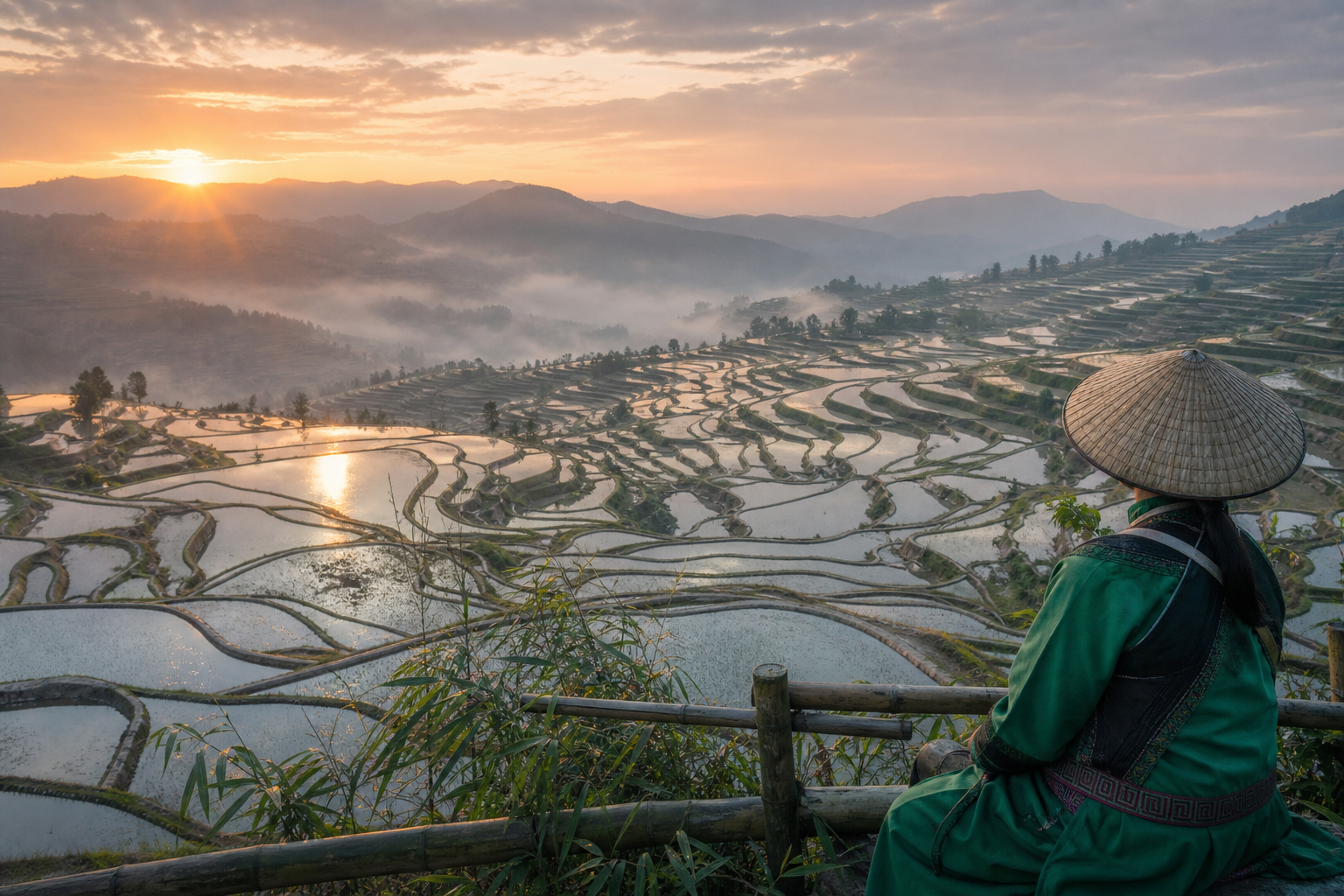
Japanese tanada — terraced rice paddies — operate at the opposite scale. Individual paddies are often smaller than 0.1 hectare each, but the precision is extreme. Vertical tolerance across a single paddy historically held to <3 cm, achieved through bamboo water-level instruments that functioned as pre-industrial laser levels. Why such precision? Because rice needs uniform standing water depth across the entire paddy. A 5 cm low spot floods seedlings. A 5 cm high spot leaves them dry. The same paddy with both problems produces a fraction of its design yield.
This is the technical threshold that matters: precision terrace alignment requires <5 cm vertical tolerance across the terrace length to maintain proper water cascading (PNAS). Larger deviations create dry spots and flooded spots in the same paddy, and propagate downstream when overflow timing breaks.
Precision is not modern luxury on hillsides — it is ancient necessity. A 5 cm difference in terrace height breaks water distribution for the entire downstream system.
Soil compaction discipline is the second engineering signature of East Asian systems. Foot traffic and animal traffic are routed along dedicated stone-faced paths to protect terrace edges. Edge collapse is the #1 failure mode for terraces globally — a single broken shoulder during a heavy rain can release the water mass of an entire paddy and trigger cascading failure of every terrace below it. The Hani and the Japanese both solved this with traffic engineering, not just wall engineering.
This is the technical point where modern precision agriculture stops being optional and becomes the natural successor to traditional measurement craft. RTK GPS autosteer delivering 2–3 cm pass-to-pass accuracy on a steer-ready tractor does four things on a terraced field that no manual operator can match consistently across an eight-hour shift:
- Aligns planting rows exactly parallel to the terrace edge, preventing wheel slip onto fragile shoulders during turn-around
- Reduces compaction by keeping every pass on the same wheel tracks (controlled-traffic farming), confining soil pressure to known corridors
- Enables consistent geometry when building new terraces or repairing collapsed walls, because the same machine guidance that plants the field can also lay the contour for earthworks
- With 4G/GSM telemetry, lets a farm manager or fleet operator monitor water channel status, machine location, and field conditions remotely — relevant when terraced parcels are 30+ minutes from the farmhouse
What ancient Hani and Japanese builders accomplished by hand at <5 cm tolerance, modern RTK systems accomplish at 2–3 cm at roughly ten times the speed. The geometry is the same. The labor cost is not. This is where precision planting alignment on terraced fields earns its keep — not by replacing the engineering knowledge embedded in traditional systems, but by executing that knowledge faster and at lower per-hectare labor cost.
A critical caveat is owed here. Dr. Paul Richards at University College London documented that "Western-engineered terraces in West Africa have 40% higher failure rates than traditional ones because they ignore localized soil knowledge embedded in indigenous terrace geometry" (Agriculture and Human Values). Precision tools do not replace site judgment. They execute it faster. An RTK system that builds a geometrically perfect terrace in the wrong location, with the wrong drainage assumptions, will fail just as decisively as a poorly built traditional terrace — only at industrial speed. The tool is downstream of the decision.
Dr. Masaaki Inbar of Kyoto University frames the deeper principle: "The true genius of terrace farming isn't just in creating flat surfaces, but in engineering water pathways that transform destructive downhill flow into productive horizontal movement. Most modern erosion control fails because they don't replicate this ancient hydraulic intelligence" (Soil Use and Management Journal). Hydraulic intelligence is the survivable asset. Geometry is the executable surface.
Modern Terrace Revivals: Ethiopia, Rwanda, Spain, and the Carbon Economics
Terracing is not only an ancient practice surviving into the present. It is also an active policy intervention in degraded landscapes worldwide. Several modern revival programs deserve specific attention as terrace farming examples that show what precision-era construction looks like.
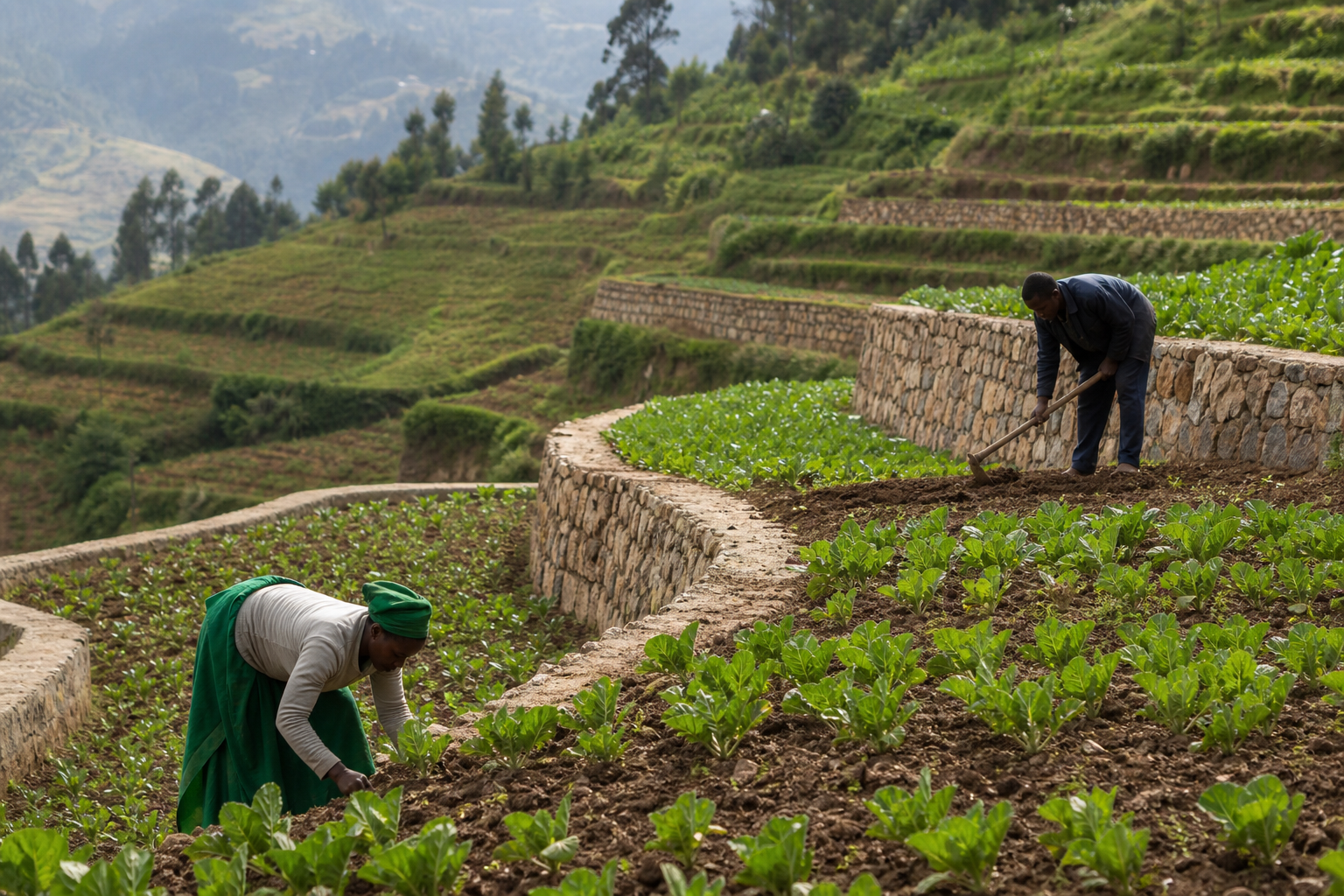
- East African terracing (Ethiopia, Rwanda, Kenya). NGO- and government-led terrace construction targets erosion-degraded slopes that conventional soil conservation cannot recover. Rwanda's national program has constructed terraces across more than 900,000 hectares since 2008. Yields recover 30–50% within three growing seasons as soil profiles stabilize and moisture retention improves. The labor is heavy and largely manual, but the alternative — continued erosion of remaining topsoil — is irreversible within human timescales.
- Spanish and Portuguese terrace revival. Abandoned Mediterranean terraces are being rebuilt under EU rural-development subsidies. The economic driver is the European Commission JRC finding that abandoned terraces produce 25–30% more erosion than equivalent conventional slope farming. Public restoration cost is now demonstrably cheaper than emergency erosion control after wall collapse. Several Spanish autonomous regions now pay per-meter of restored dry-stone wall.
- Climate adaptation in drylands. Terraces are being deployed in the Sahel and parts of South Asia as water security infrastructure — slowing runoff to recharge aquifers rather than only to grow crops. Soil moisture retention rises 25–35% in dry seasons under terraced regimes (UNESCO). The yield benefit is secondary to the groundwater recovery benefit at watershed scale.
- Precision terracing pilots. Taiwan and Colombia are running laser-guided new-construction projects where RTK GPS-aligned earthmovers achieve consistent terrace geometry at industrial speed. The earthmoving pass is followed by RTK-guided planting passes using the same coordinate frame. This pairs naturally with data-driven yield forecasting on terraced fields, where consistent geometry produces consistent treatment zones for the first time in terraced agriculture.
- Carbon and biodiversity economics. Terrace farming systems support 18% greater biodiversity than conventional hillside farming, according to Dr. Thomas Newbold at UCL: "The key is the mosaic of habitats created by terrace walls, drainage channels, and varied crop zones that function as ecological corridors" (Nature Communications). Some EU schemes now compensate terrace maintenance via biodiversity payments and carbon credits, monetizing what was previously an unfunded public good.
- The labor bottleneck — an honest assessment. Dr. Eduardo Rojas-Briales, former FAO Assistant Director-General, warns that "without economic incentives, terrace maintenance becomes intergenerational burden rather than asset, leading to abandonment at rates of 3-5% annually in Southeast Asia" (FAO Policy Brief). Without mechanization, subsidy, or biodiversity payments, traditional systems decay regardless of their historical resilience. The revival programs above work precisely because they address the labor economics, not only the engineering.
The implication for an individual farmer with sloped land is direct: terraces are recoverable. They are also worth recovering. But the decision requires a structured framework, not nostalgia.
Should You Terrace Your Slope? A Decision Framework with Precision-Agriculture Economics
This is the working framework. Walk through it with your own land in mind.
Part A — Site Assessment Checklist
- Measure slope angle. Terracing is cost-effective above 15° (26.8% grade) per USDA NRCS guidance. Below 10°, contour plowing with cover cropping usually beats terracing on net economics.
- Confirm water source year-round. A seasonal-only water supply flips a wet-rice terrace plan into a dry-terrace plan with completely different wall geometry and crop options.
- Test soil depth. Less than 30 cm over bedrock means terrace soil must be imported or built up over multiple seasons. Plan for a multi-year project, not a single construction season.
- Calculate labor availability. Southeast Asian-style wet systems need 15–20% of annual labor; Andean tuber systems need 10–15%; Mediterranean stone-walled systems need 5–10%. Match the system to the labor you can actually sustain.
- Identify crop market access. Olives, grapes, specialty rice, seed potatoes, and certified-organic produce pay for terrace economics. Commodity grains generally do not. The crop must clear a price premium that conventional flatland competition cannot match.
- Estimate construction cost per hectare. Regional variance is wide — roughly 3x to 20x depending on stone availability, labor cost, and machinery access. Get three local quotes before committing.
- Confirm bedrock and drainage stability. Shallow bedrock with poor drainage causes terrace failure even with perfect wall construction. A geotechnical survey is cheaper than a collapsed terrace.
- Check climate trend. Drying regions favor dry-stone, wide-step systems; wetting regions favor channeled wet terraces with reinforced spillways. Build for the next thirty years, not the last thirty.
- Assess equipment access. Can a tractor reach the slope? Steer-ready tractors with RTK autosteer meaningfully reduce per-hectare planting and harvest labor on aligned terraces, but only if the equipment can physically reach the field.
- Define payback timeline. Tree crop terraces: 7–15 years to full payback. Rice or annual terraces: 3–7 years. Anything beyond 15 years requires either subsidy or carbon/biodiversity payments to close. For a deeper view into the broader benefits of sustainable terrace systems, the financial framing extends beyond crop yield alone.
Part B — The Investment Matrix
| Factor | Green Light | Yellow Caution | Red Flag |
|---|---|---|---|
| Slope angle | >15° | 10–15° | <10° |
| Water source | Year-round | Seasonal | Scarce / none |
| Soil depth | >60 cm | 30–60 cm | <30 cm |
| Crop market | Premium demand | Niche / variable | Weak / declining |
| Payback timeline | <7 years | 7–15 years | >15 years |
A field with four or more Green Lights is a strong candidate. A field with two or more Red Flags should be reconsidered — either with a different crop choice, a different system design, or a decision to invest the capital elsewhere.
Terracing is a multi-generational asset. The payoff is not this season — it is the next two hundred years of soil.
Part C — Where Precision Agriculture Changes the Math
The economics of terracing have shifted measurably in the last decade, and the shift is concentrated in three places.
First, RTK GPS autosteer at 2–3 cm accuracy prevents wheel slip onto fragile terrace shoulders — addressing the #1 global terrace failure mode directly. Every wheel that does not crush a shoulder is a wall repair that does not need to happen.
Second, controlled traffic from autosteer means every pass uses the same wheel tracks year after year. Compaction concentrates in known corridors rather than spreading across the entire growing surface. On narrow terrace beds, this is the difference between consistent yield and a patchwork of compacted dead zones.
Third, 4G/GSM telemetry — the advanced configuration of Agro Navigator's hardware — allows remote monitoring of water channel status, machine location, and field conditions. When terraced parcels are 30+ minutes from the farmhouse and weather windows are tight, the ability to see what is happening in the field without driving to it has direct dollar value in saved time and faster intervention.
The iOS-native interface (iPad/iPhone) eliminates the legacy Windows PC requirement that historically made AgOpenGPS builds awkward in a tractor cab. A terrace edge is no place for fragile desktop electronics. And the planned multi-vehicle coordination roadmap opens the door to small farm fleets sharing equipment across terraced regions where individual operators cannot justify the capital alone.
Walk the slope this week. Take a measuring tape, an inclinometer app on your phone, and the matrix table above. Mark the slope angles, soil depths, and water sources at five points across the field. The decision is in the data — not in nostalgia for the way it used to be done, and not in salesmanship for the way the brochures say it should be done now.
Terrace Farming: Four Questions Farmers Ask Most
Q1: Which crops are best suited to terrace farming?
Match crop to water regime. Monsoon climates with cascading water support rice (Southeast Asia, East Asia, 3–5 t/ha). Cool altitude with seasonal water supports potatoes, quinoa, and beans (Andes). Dry summers with stone-wall retention support olives, grapes, and citrus (Mediterranean, 1.5–2.5 t/ha olives). Match the crop to the climate and the geometry follows. Reference: FAO Comparative Analysis.
Q2: How does precision autosteer reduce terrace farming costs?
Three concrete levers. First, 2–3 cm RTK accuracy prevents wheel slip onto fragile terrace shoulders — the #1 global failure mode. Second, controlled traffic confines compaction to known wheel paths, protecting the growing surface. Third, 4G telemetry enables remote monitoring of water channels and equipment, cutting site-visit overhead. An iOS-native interface on iPad or iPhone removes the legacy Windows PC requirement of community AgOpenGPS builds.
Q3: Can I build new terraces on a slope I've farmed flat?
Yes, but treat it as a 3-to-10-year project. Year 1: measure, plan, source materials, and consult a geotechnical surveyor. Year 2–3: construction in phases — never strip an entire slope at once, because partial-collapse risk during construction is real. Year 3 onward: planting and water channel commissioning. Payback runs 7–15 years for tree crops and 3–7 years for annuals assuming a premium crop market.
Q4: How much does terrace maintenance actually cost annually?
Region- and system-dependent. Southeast Asian rice systems consume 15–20% of annual farming labor. Andean tuber systems consume 10–15%. Mediterranean stone-walled tree crop systems consume 5–10% (PMC). Precision autosteer and telemetry reduce the equipment-related share of this labor by streamlining planting, spraying, and harvest passes — they do not eliminate the manual stone-wall repair, water-channel clearing, or pruning labor that defines the terraced production system.