

Farmers Walk Benefits: Why This Functional Exercise Belongs in Every Farmer's Routine
Farmers Walk Benefits: Why the Loaded Carry Is the Most Job-Specific Strength Exercise a Farmer Can Do
The barn door light flickers on at 7:42 p.m. You've been moving since before sunrise. The last feed bag hits the concrete and you flex your right hand — the one that's been gripping something since lunchtime — and the fingers won't close all the way. Not pain, exactly. Just the body filing a complaint. The grip went somewhere around hour eight, the lower back somewhere around hour ten, and the shoulders have been doing the slow burn of micro-corrections behind a steering wheel that doesn't know how to drive itself.
Here's the quiet irony: the gym exercise named for you — the farmers walk — is also, by accident or honest design, the closest gym movement to what you actually did all day. Pick up heavy things, walk them somewhere, set them down, repeat. Grip, posture, anti-rotation, grit. The farmers walk benefits that matter for working farmers are not the ones you'll read about on a fitness blog written for desk workers. They're the ones that show up at hour nine, when the kind of strength that holds your day together is the kind that doesn't fail under sustained, awkward, real-world load.
What follows is what the movement is, what it actually delivers when you do it right, how to build it from what's already in the barn, and how it fits next to the ergonomic technology now reshaping the cab.
Table of Contents
- The Physical Job Description of Modern Farming
- What a Farmers Walk Actually Is
- Five Farmers Walk Benefits That Show Up Before You Reach the Tractor Cab
- Building a Farmers Walk Routine From What's Already in Your Barn
- Strength Training and Precision Agriculture
- Four Mistakes That Turn Farmers Walks Into Injuries
- Your First Four Weeks: A Loaded-Carry Build for Working Farmers
The Physical Job Description of Modern Farming
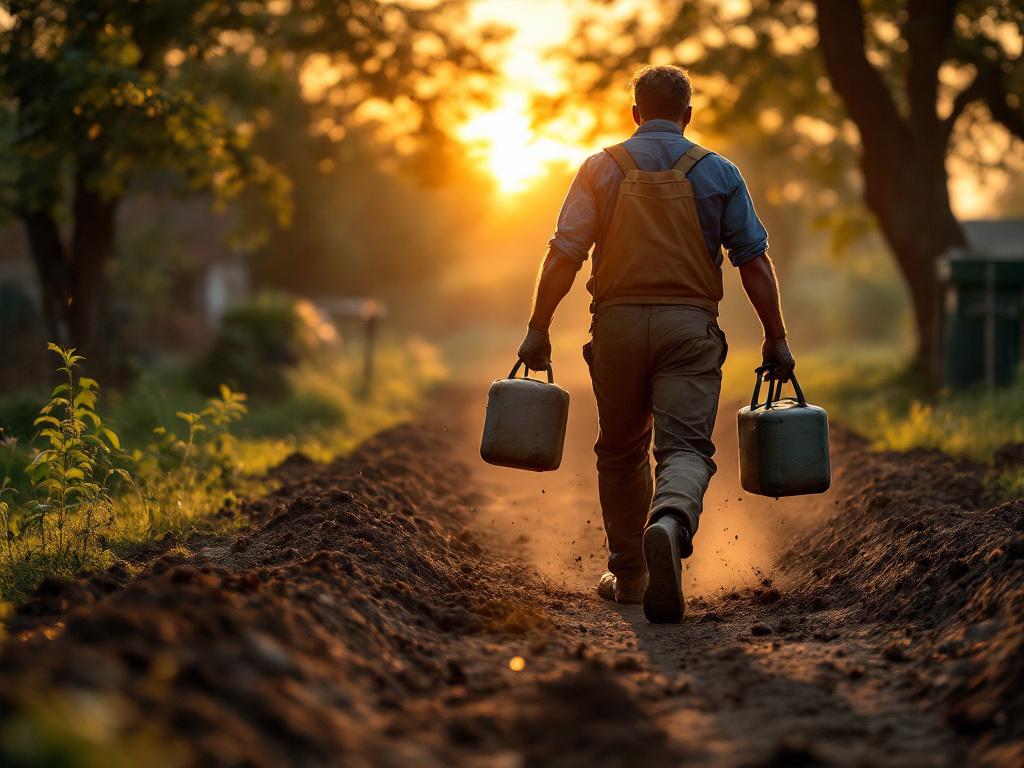
Farming, considered honestly, is a sport. Not a metaphor — a sport. It has a season, a peak load, a recovery cycle, and a body of specific physical demands that injure the people who play it. Occupational health bodies including the U.S. National Institute for Occupational Safety and Health (NIOSH) consistently rank agriculture among the most physically demanding civilian occupations, with elevated rates of musculoskeletal disorders affecting the lower back, shoulders, hands, and wrists. The injuries don't come from a single catastrophic event most of the time. They come from years of the same patterns, repeated under load, on uneven ground, by a body that was never trained for them.
Pay attention to the patterns that recur in a working day, and the physical job description starts writing itself.
Loaded asymmetric carries. You almost never carry two equal weights, balanced, walking on flat ground. You carry one bucket of feed in one hand. One bale on a hip. One chainsaw, one fence post, one toolbox, one calf. The load is always on one side, the ground is rarely flat, and the distance is always longer than you remembered. Your core spends the entire walk resisting lateral flexion — the sideways bend that wants to happen when weight pulls down on one shoulder.
Static grip endurance. Sustained grip is the silent limiter of the farm day. Your hand closes around a steering wheel at 6 a.m. and doesn't really open until lunch. Pliers, fencing tools, hammer handles, milking clusters, ratchet straps, hydraulic lines — the forearm flexors stay contracted under low-grade load for hours. Grip strength is not what's tested when you shake someone's hand. Grip strength is what's tested at hour nine when you still need to crimp a fence wire.
Anti-rotation core demand. Mounting a tractor cab from the side is an anti-rotation task. Lifting a calf from a pen is an anti-rotation task. Hand-cranking a stuck PTO shaft is an anti-rotation task. Every time the load is off-center and the spine has to refuse to twist, the obliques, transverse abdominis, and deep spinal stabilizers do the work. Train them or they fail — and when they fail, the lumbar spine usually pays the bill.
Postural endurance under vibration. Eight to twelve hours in a tractor or combine seat compresses the lumbar discs, fatigues the spinal erectors, and feeds whole-body vibration up through the trunk. The trapezius and rhomboids take a sustained low-grade load just from holding the head and arms in working position. This is the kind of fatigue that doesn't register as "hard" — it registers as "I just feel old today."
Repetitive shoulder elevation. Latching gates, throwing tarps, working overhead on hydraulic lines, reaching to clear a header. The shoulder joint is doing what it's worst at — sustained elevation under load — and the rotator cuff pays the eventual price.
Now contrast this with what most fitness programs assume. Symmetrical barbell lifts, isolation machines, treadmills, controlled environments, even sets and reps, a mirror. A farmer who trains like a bodybuilder will look the part and still be the one whose lower back gives out at the third hour of fence repair. The problem isn't effort. The problem is specificity. The farmer's body needs to handle uneven, sustained, real-world load patterns held over time on unforgiving ground — and almost nothing in the standard fitness vocabulary trains exactly that. Almost nothing, except the one exercise that copied its name from the job.
Farmers don't have a fitness problem. They have a sport-specific problem — and the sport is the job itself.
What a Farmers Walk Actually Is
The movement is simple to describe and unforgiving to perform correctly. If you've seen it done badly — and you have, in every gym — you've seen it done as a shrugged-shoulder waddle with a death grip and a held breath. That isn't the farmers walk. That's a way to hurt yourself with heavy things.
Done correctly, the mechanics are the entire exercise.
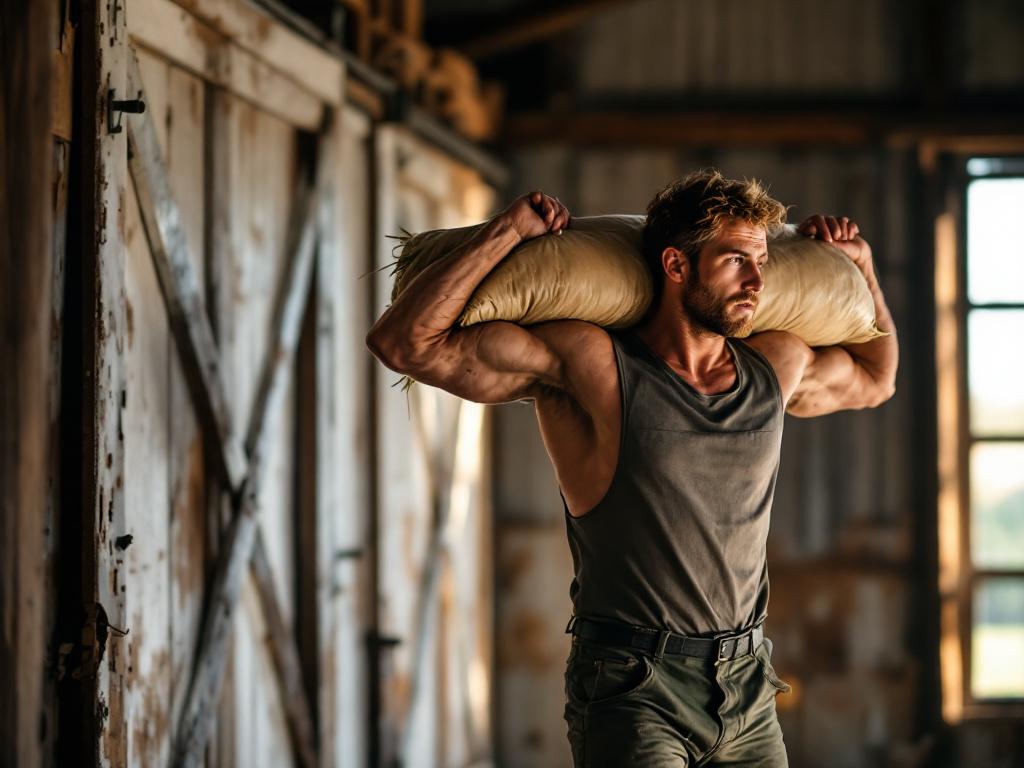
- Setup. Two heavy implements, one in each hand. Dumbbells or kettlebells if you have them. A trap bar if you train at a serious gym. If you don't have any of that — and most working farmers don't — you have jerry cans, feed sacks, sandbags, or 5-gallon buckets filled with gravel or water. The load hangs at arm's length, even on both sides for the standard version.
- Posture. Chest tall but not arched. Shoulders pulled down and back, not shrugged up toward the ears. Spine neutral — not flexed, not hyperextended. Core braced as if you were expecting someone to punch you in the stomach. The brace is continuous, not pulsed.
- Gait. Short, deliberate steps. The hips do not sway side to side; the load does not swing. Eyes forward, not down at the load. You walk the way you'd carry a full coffee cup, except the cup weighs forty pounds.
- Breathing. Continuous. Through the nose where possible. The instinct on heavy carries is to hold the breath, and that instinct is wrong — held breath spikes intrathoracic pressure and tanks endurance. Breathe.
- Duration. Distance- or time-based. A reasonable starting target for a working farmer is 40 to 60 seconds of continuous carry, or 20 to 40 meters per set. Posture is the cap, not the clock. The set ends when posture breaks, regardless of time on the watch.
- Variations worth knowing.
- Suitcase carry — load in one hand only. The single most useful variation for farmers, because it mirrors single-bucket work and ruthlessly exposes left-right imbalance.
- Front-rack carry — load held at shoulder height, elbows up. Brutal on posture and breathing. Builds the thoracic strength that holds a chest cavity open under load.
- Overhead carry — load pressed overhead. Difficult, demanding, and almost the only gym exercise that trains the exact shoulder pattern of overhead farm work.
- Yoke walk — a loaded yoke across the upper back. Advanced equipment territory. Skip until basics are clean.
Now the analytical payload — why these mechanics map almost perfectly to farm work.
The grip pattern is isometric flexion under sustained load. That is the exact contraction your forearm performs when you hold a steering wheel through vibration, a fencing tool through a long afternoon, or a milking cluster through a milking round. Training grip with brief crushing efforts on a hand gripper builds peak strength but not the endurance the job actually demands. The carry trains the right thing.
The bracing pattern — a continuous, breathing-compatible core lock — is the same brace you need every time you lift a single bucket off the ground, climb a step into the cab carrying a tool, or stabilize a load on uneven ground. The suitcase carry is the cleanest training analog of one-handed farm carries, and the asymmetry it exposes is the same asymmetry that quietly builds chronic lower-back trouble in farmers who favor a dominant side.
The postural pattern — packed shoulders, stacked spine, eyes forward — is identical to what your body needs to hold for hours in the cab. Train it under heavy short-duration load, and the long-duration low-load version starts feeling easier. The transfer is direct.
Five Farmers Walk Benefits That Show Up Before You Reach the Tractor Cab
A note on what follows: each of these farmers walk benefits is tied to a specific farm task, not a generic fitness outcome. If a benefit doesn't change something measurable about the working day, it isn't on this list.
- Grip strength that lasts past lunch. Sustained grip is the limiting factor in fencing, hand-milking, post-driving, ratchet-strap work, and steering on rough ground. The farmers walk trains the forearm flexors isometrically under load — the exact contraction profile of holding tools. Unlike grip-crusher work, which builds peak strength in two-second bursts, the carry builds the time-under-tension version of grip. The kind that doesn't surrender at hour nine. Practitioner experience consistently shows that grip endurance is the first observable adaptation, often within two to three weeks of consistent carries.
- Anti-rotation core stability for uneven loads. Every time you carry one bucket, one bale, or one chainsaw, the core resists lateral flexion. The suitcase carry variation directly trains this pattern and exposes left-right imbalances that quietly build into chronic lower back and sacroiliac joint pain. Strength practitioners commonly recommend training the weaker side at higher volume, not equal volume, because the body has been compensating for the imbalance long enough to make symmetry feel weird. It isn't weird. It's correction.
- Trapezius and scapular endurance against vibration. Tractor and ATV vibration travels up through the arms into the trapezius and upper back, where it accumulates as a low-grade contraction that ends the day as a sharp ache. Stronger postural muscles fatigue more slowly under the same vibration load. The farmers walk forces the upper back to stabilize the shoulder girdle for the entire duration of the carry — exactly the demand a long cab session imposes, only compressed into a minute.
- Postural resilience for long cab days. Sitting under spinal compression for eight to twelve hours degrades posture by sheer time. A loaded carry trains the deep spinal stabilizers — erectors, multifidus, transverse abdominis — in an upright position, which is the position those muscles actually need to work in. Crunches train the spine in flexion. Carries train it in the position you live in. The difference shows up on the second cup of coffee of a long day.
- Work capacity at a metabolic level. Heavy carries elevate heart rate to a degree most strength exercises don't. Two or three carries done back-to-back deliver conditioning that translates to "still moving fast at 4 p.m." rather than "good at running a 5K." For a farmer, that distinction is the whole game. Aerobic capacity built on a treadmill doesn't transfer cleanly to load-bearing work. Aerobic capacity built under load does.
| Farm Task | Trained Capacity | Best Variation |
|---|---|---|
| Carrying feed buckets | Grip + anti-rotation | Suitcase carry |
| Long steering sessions | Grip + posture | Standard carry |
| Climbing into the cab | Hip + bracing | Front-rack carry |
| Overhead gate / tarp work | Shoulder endurance | Overhead carry |
| Fence post driving | Full-body bracing | Yoke walk |
Building a Farmers Walk Routine From What's Already in Your Barn
You do not need a gym membership, a trap bar, or anything in a catalog to start. You need two heavy things, a known distance, and the willingness to do it twice a week without skipping. The barriers to this exercise are not equipment. They are time and discipline, and both are problems you already solve every morning.
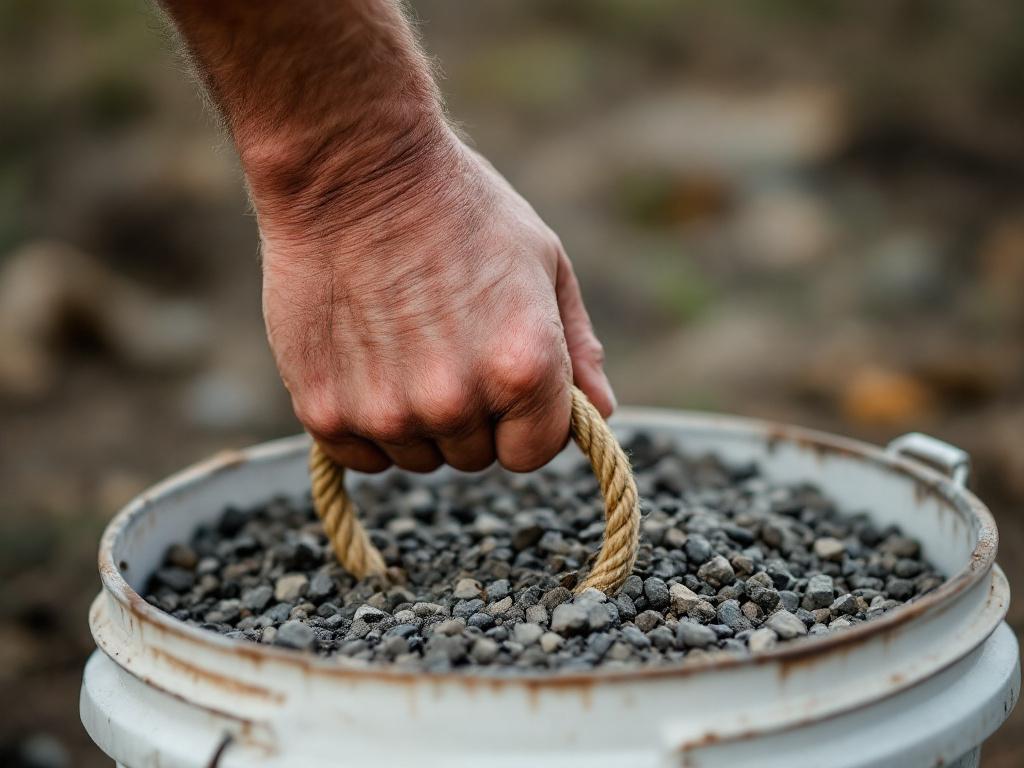
- Audit your improvised loads. A 5-gallon bucket of water weighs about 40 lb. A 50-lb feed sack is exactly what it says. Jerry cans (full of water, not fuel) come in at roughly 40 lb for a 5-gallon model. Sandbags are infinitely scalable and brutal because the load shifts. Concrete-filled paint buckets with a rebar handle make a permanent training load for the cost of a bag of mix. Set up two or three load options at different weights — light, working, heavy — and keep them somewhere you can grab them without thinking about it.
- Establish a baseline. Walk a known distance — barn door to the gate, post to post, truck to shed, whatever is roughly 30 meters — carrying a moderate load. Note the time. Note the load. Note which hand fatigued first. That asymmetry is not a problem to ignore; it's the most useful piece of training information you'll collect this month. Most working farmers fatigue on the non-dominant side first, but a meaningful minority — particularly those who handle tools right-handed but carry left-handed out of habit — break the other way.
- Set a frequency. Two sessions per week is the floor for adaptation. Three is better. Each session is three to five carries, with rest between sets that's long enough to maintain posture on the next one — usually 60 to 90 seconds. Total time investment, warm-up included: roughly 10 to 15 minutes. There is no fitness program with a better return on time for a working farmer.
- Progress one variable at a time. Add distance, add load, or add a harder variation — never two at once. The rule that holds up under hard use: when you can complete all sets cleanly with current parameters, increase load by about 10% or distance by roughly 25%, then hold there until clean again. Doubling both at once is how people end up with strained wrists and a week off.
- Integrate with existing work. A 90-second carry before chores is a warm-up. A heavy carry after chores is a finisher. The exercise doesn't need its own time block, its own outfit, or its own location. The barn aisle is fine. The yard between the house and the shop is fine. The path to the gate is fine. The point is that it gets done — and a routine that lives where the work already happens gets done.
- Recover deliberately. Grip and forearm tissue recovers more slowly than larger muscle groups. Do not carry heavy two days in a row if your hands are still tight from the last session. Tightness in the morning that doesn't clear within a few minutes of moving is a signal to reduce load or skip a day. Sustained tightness across days is a signal to back off for a week. The exercise is supposed to build reserve, not spend it.
The best farmers walk routine is one you can build from what's already in your barn. You don't need equipment — you need intent and a clear distance to the gate.
Strength Training and Precision Agriculture: Where the Farmer's Body Meets the Modern Cab
Strength has a ceiling. So does technology. The interesting work happens where they meet — and for a working farmer, that meeting point is the cab.
Consider what manual steering actually demands of the body over a long pass. Constant micro-corrections, each one a small contraction of the forearms, shoulders, and trapezius, repeated several times per minute across hundreds of passes per day. None of the individual corrections are hard. The cumulative load is what eats the afternoon. By hour nine, the muscles that held the wheel are the same muscles you now need to lift a calf, hook up an implement, or carry a tool the length of a field — and the reserve isn't there. The exhaustion isn't dramatic. It's just a slow flattening of capability across the back half of the day.
RTK autosteer changes the equation, but not the way the marketing copy usually frames it. Autosteer doesn't make you fitter. It returns reserve to the parts of your body that the technology cannot help. Your grip arrives at the next manual task less depleted. Your shoulders haven't been doing micro-contractions for nine hours straight. Your attention is on decisions about the work, not on holding a line. The strain that gets offloaded is exactly the strain no amount of training can fully outlast, because the issue is duration, not intensity.
| Physical Demand | Manual Steering, 8-Hour Day | RTK Autosteer-Assisted Day |
|---|---|---|
| Sustained grip on wheel | Continuous, low-grade | Intermittent, minimal |
| Micro-correction shoulder load | High, repetitive | Largely eliminated |
| Postural vigilance | High (line of sight) | Reduced (passive monitoring) |
| Decision fatigue | High | Significantly lower |
| End-of-day reserve | Low | Substantially higher |

The two interventions don't compete. They compound — and they cover different gaps. Strength training, specifically loaded carries, builds the reserve that gets spent on the manual tasks autosteer cannot do for you. Hooking up an implement is still your hands. Walking a field for scouting is still your legs and lower back. Hand-fixing a hydraulic line at the headland is still your grip. None of that is automatable today, and none of it is helped by a stronger steering motor. It is helped by a stronger you. Meanwhile, autosteer protects the reserve that strength training builds. A farmer who arrives at the hydraulic line at hour ten with a grip that hasn't been holding a wheel for nine hours can actually finish the repair without it becoming an injury.
The same logic extends to telemetry. On Agro Navigator's 4G-equipped configuration, real-time GPS data and remote monitoring through the online dashboard mean fewer trips out to the machine to check status, fewer climbs in and out of the cab to verify a pass, and fewer minutes spent in physical positions the body would rather not be in. Each trip avoided is a small ergonomic deposit. They add up the same way the micro-corrections add up, only in the right direction.
A useful way to think about the relationship: strength training is the part of the system you build, autosteer is the part you install, and telemetry is the part that prevents you from re-spending what the other two gave back. Farmers who run all three describe the same observation in different words — they're not less tired because they did less. They're less tired because the right tools and the right body absorbed the parts of the day that used to wear them down. The same ergonomic dividend extends to scouting work assisted by satellite imagery for farm management, which trims the unnecessary trips across a field before they cost you anything physical.
Strength and technology aren't competitors. A loaded carry shores up what ergonomic gear can't reach — and modern autosteer handles the strain no amount of training can outlast.
Four Mistakes That Turn Farmers Walks Into Injuries
The exercise looks simple, and that's the problem. Simple movements done badly under load find the weakest joint in the chain and break it. These four mistakes account for almost every avoidable injury on the carry.
| Mistake | Why It Happens | Consequence | Correction |
|---|---|---|---|
| Loading too heavy too soon | Underestimating grip vs. leg strength | Wrist strain, lower back tweak | Start with a load you can carry 60 seconds clean |
| Shrugging shoulders up | Heavy load pulls traps into elevation | Neck tightness, impingement risk | Pack shoulders down and back; reduce load if needed |
| Ignoring left-right asymmetry | Most farmers have a dominant carry side | Reinforced imbalance, chronic SI pain | Add suitcase carries on the weaker side only |
| Treating it as cardio | Rushing the walk, sloppy posture | No strength gain, elevated injury risk | Slow the gait; posture is the exercise |
Each error has a farm consequence, not just a gym consequence. Loading too heavy too soon doesn't just hurt the wrist on Tuesday — it leaves the same wrist compromised on Wednesday when you need it to hold a wrench for an hour. Shrugging the shoulders under load builds the same upper-trap dominance that vibration in the cab already encourages, and the two problems stack into the kind of neck tightness that doesn't clear on a weekend.
The asymmetry mistake is the one worth dwelling on. A farmer who carries everything on the right side at work, and then trains carries equally on both sides at home, is still leaving the left side under-loaded relative to the demand the body actually faces. The correction is counterintuitive: train the weaker side at higher volume, not equal volume. Two suitcase carries on the weaker side for every one on the stronger side, until the asymmetry closes. Then maintain. Most farmers find this takes four to eight weeks of deliberate work, and the SI joint discomfort that quietly accompanied the imbalance often resolves alongside it.
Treating the carry as cardio is the gym-culture mistake. Rushing the walk, breathing badly, letting the load swing — none of it builds the postural and grip adaptations the exercise exists to deliver. Slow it down. Posture is the exercise. Distance is what you get for free when posture is right.
A short clinical note: any farmer with existing lower-back, shoulder, or wrist injury should clear a loaded-carry program with a clinician before starting. The exercise is forgiving for healthy bodies and unforgiving for compromised ones.
Your First Four Weeks: A Loaded-Carry Build for Working Farmers
What follows is a four-week implementation block designed for a working farmer with no training base and access to nothing more sophisticated than two 5-gallon buckets. Each week introduces one new variable. Nothing earlier is repeated, and nothing later is added before the foundation is solid.
Week 1 — Establish the Pattern
- 2 sessions, 3 carries per session, roughly 30 meters per carry
- Load: about 40–50 lb per hand (one full 5-gallon water bucket per side is a fair starting point for most working farmers)
- Focus: posture under load. Drop the bucket the second posture breaks. No exceptions.
- Checkpoint: Can you complete 30 meters without shoulders shrugging up toward the ears?
Week 2 — Introduce Asymmetry
- 2 sessions, 2 standard carries + 1 suitcase carry per side
- Same load as Week 1
- Focus: which side fatigues first. Note it. The answer is the assignment for Week 3.
- Checkpoint: Can you maintain a level pelvis on the suitcase carry, or does the loaded side dip?
Week 3 — Progress One Variable
- 3 sessions, choose one progression only: roughly +10% load OR about +25% distance
- Add a second suitcase carry on the weaker side identified in Week 2
- Focus: maintain Week 1 posture standard at the new load or distance
- Checkpoint: Are your forearms recovered within 24 hours? If not, hold the current load and reduce frequency to two sessions for the week.
Week 4 — Test and Measure
- 1 retest at Week 1 load, maximum distance with clean posture
- 2 working sessions at Week 3 parameters
- Focus: compare the retest distance to Week 1 baseline
- Checkpoint: Expected outcome is roughly 25–50% greater distance, or noticeably reduced perceived effort at the same distance. Decide the next block: add a heavier carry day, or rotate in the front-rack variation.

An operator's note to close the block. The farmer who completes four weeks of this work has built measurable grip and postural reserve — not the reserve that wins a competition, but the reserve that finishes a Thursday in October without the body filing a complaint. Pair that reserve with the ergonomic offload that precision agriculture provides on a steer-ready tractor, and the working day stops accumulating wear in the same way it used to. The grip arrives at the last task with something left. The shoulders have something left. The decisions stay sharp through the back half of the day. Strength does the part technology can't, technology does the part strength can't, and the farmer at the barn door at 7:42 p.m. flexes a hand that closes all the way.