
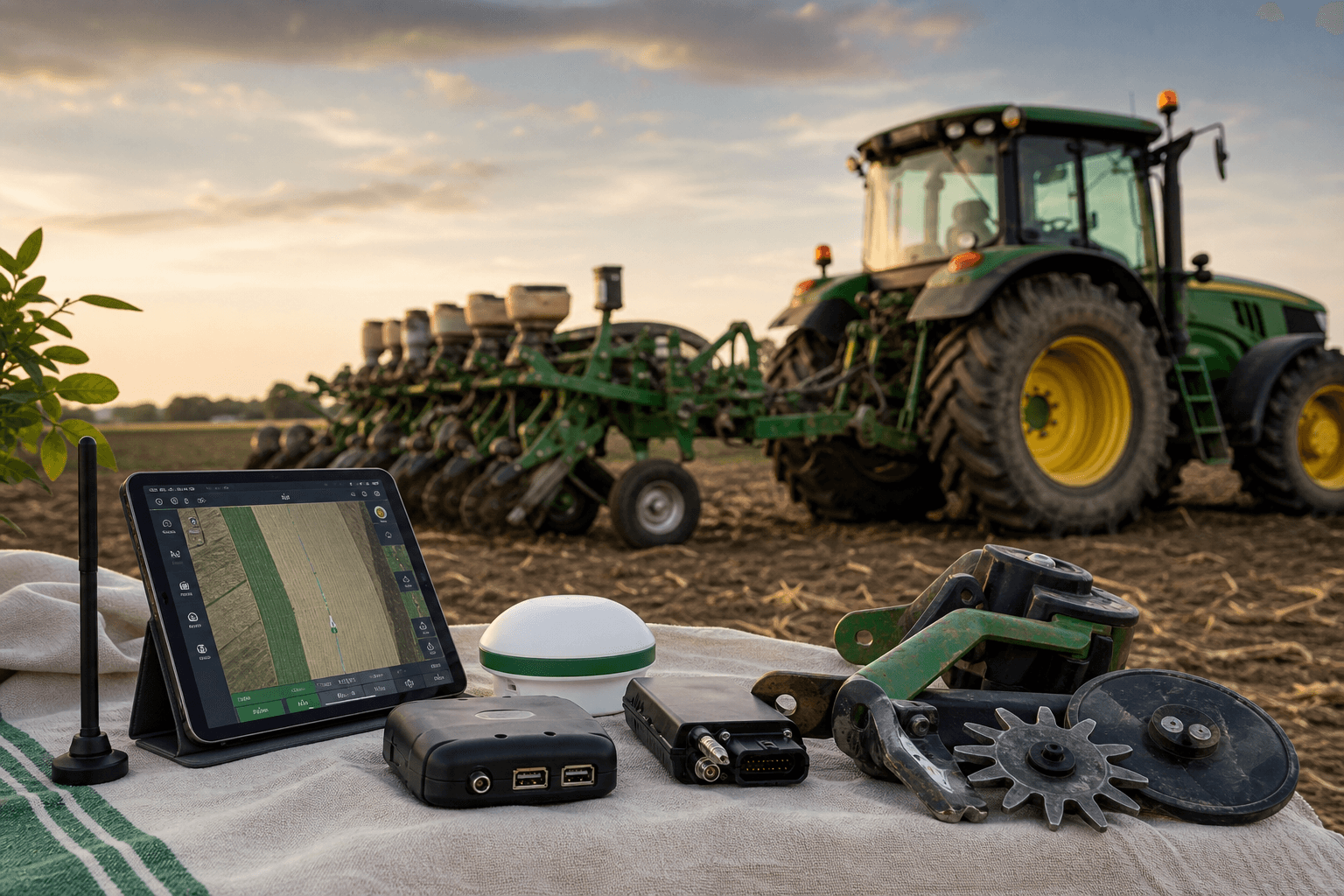
Essential Tractor Attachments for Precision Farming in 2026
Autosteer drives your tractor straight. The implement decides whether your inputs land where they pay. If you've already invested in RTK guidance — or you're evaluating an AgOpenGPS-compatible stack — the next ROI question is not about your cab. It's about every tractor attachment behind it. According to USDA Economic Research Service data, roughly 70% of U.S. corn acres run GPS guidance, but only 16–37% use variable-rate technology on seeding or fertilization. That gap is the value being left in the field. The rest of this article resolves it: which attachments convert RTK accuracy into yield and input savings, how they talk to your guidance stack, when to retrofit versus replace, and a printable specification checklist for evaluating any implement against an open-platform setup.

Table of Contents
- Why Your Implement — Not Your Autosteer — Caps Your Precision ROI
- The Four Attachment Categories That Define Precision Output
- Sensor Integration: How Implements Actually Talk to RTK Guidance
- Retrofit or Replace: The Implement Age Decision Framework
- Building an AgOpenGPS-Compatible Attachment Stack
- Pre-Purchase Specification Checklist: What to Ask Before You Sign
Why Your Implement — Not Your Autosteer — Caps Your Precision ROI
RTK GNSS guidance delivers 2–3 cm pass-to-pass accuracy under ISO 12188-1 test procedures, validated in field work at the University of Missouri Agricultural Engineering program and others. That compares to 20–30 cm for WAAS/DGPS-level correction and over 50 cm for manual driving. But this accuracy only matters to the extent your tractor attachments can act on it. The antenna position is one number. The application point is another. They are not the same number.
There are three reasons the implement is the actual ROI lever — not the guidance receiver.
First, application accuracy is bounded by the implement's mechanical and electronic precision, not the GPS. Dr. John Fulton of Ohio State University Extension puts it plainly: precision happens at the tool engaging the soil or crop, not at the GPS antenna. A worn nozzle, a leaking valve, or a miscalibrated seed meter erases sub-inch positioning gains. Dr. Joe Luck at UNL Extension makes the same point in his sprayer technology guides: worn nozzles and valves quickly erase the advantages of RTK-level positioning. Your guidance line can be perfect while your spray pattern is 20% off target — and the GPS log will never show it.
Second, the economic gap between guidance adoption and VRT adoption is the value being left on the table. A separate USDA ERS analysis on adoption of precision agriculture shows yield monitors on 50–60% of corn and soybean acres but VRT fertilizer on only about 28% (corn) and 30% (soy). The translation is direct: farms are collecting data they are not using to drive implement-level control. The autosteer has been bought. The implement upgrade has not. That gap is exactly where improving on-field productivity through better input placement becomes a defensible profit line rather than a marketing claim.
Third, guidance error must be bounded relative to implement width. The ASABE engineering rule-of-thumb states that guidance error should be significantly smaller than half the implement's effective width divided by the desired overlap margin. For a 30 m boom targeting under 2% overlap, error must stay in the low single-digit centimeters. UNL and OSU Extension analyses by Luck and Fulton calculate that a 30 m boom with 20 cm lateral error generates roughly 1.3% area overlap on its own — before any operator error or section-control delay. RTK is justified only if the boom itself has section control fine enough to act on the precision it provides. A 5-section manual boom cannot consume 2 cm accuracy. A 13-section automatic boom can.
Dr. Raj Khosla's widely-cited framing of precision agriculture — the right input, at the right place, at the right time, and at the right rate — splits cleanly along this line. The first two are GPS problems. The last two are implement problems. An RTK upgrade without an implement audit only solves half the equation.
A 40,000-dollar RTK system bolted to a 20-year-old spreader is a Formula 1 engine driving a wheelbarrow. The bottleneck moves. It does not disappear.
So which RTK autosteer attachments matter, and how do they differ in what precision actually means at the tool? That is the next decision.
The Four Attachment Categories That Define Precision Output
Tractor attachments for precision farming fall into four functional categories defined by what they place into the field and how electronically responsive they are: boom sprayers, granular spreaders, precision seeders and planters, and tillage or soil-engagement implements with sensors. Each has its own definition of precision, its own controlling standard, and its own cost premium over a conventional baseline.
| Category | Precision Mechanism | RTK-Enabled Advantage | Sensor Integration Standard | Cost Premium Over Base |
|---|---|---|---|---|
| Boom sprayers | Flow control, pressure feedback, section/nozzle shutoff | 4–18% chemical savings via auto section control | ISOBUS TC, flow meters, pressure sensors | $20,000–$50,000 |
| Granular spreaders | Variable-rate metering, section control, CV <10–15% | 10–20 kg/ha N reduction at maintained yield | ISOBUS rate controller; tray-test calibration | $5,000–$10,000 entry |
| Precision seeders/planters | Singulation >97%, spacing CV <15%, electric meters | Consistent row placement; downforce per zone | ISOBUS, per-row ECUs, downforce sensors | $15,000–$40,000 |
| Tillage with soil sensors | Depth control, optional EC/moisture sensors | Zone-based depth and residue management | CAN depth controllers; optional ISOBUS | $3,000–$15,000 retrofit |
Boom sprayers are the category with the cleanest precision logic. UNL field studies led by Joe Luck show 3–10% overlap reduction and 4–18% chemical savings with automatic section control compared with manual operation. The 4–18% spread tracks field shape — irregular fields with point rows and waterways benefit most. Older sprayers with 3–5 large manual sections cap savings at roughly 5–7%, because the section granularity cannot match the field's geometry. Modern 7–13-section or individual-nozzle systems routinely exceed 10% on the same fields.
Granular spreaders are governed by EN 13080 and ISO 5690, which target a coefficient of variation under 10–15% across the swath. Variable-rate fertilizer studies — Bongiovanni and Lowenberg-DeBoer (2004) and Miao et al. (2011) — report nitrogen reductions of 10–20 kg/ha with neutral-to-positive yield outcomes. Net profit, however, ranges from roughly –5 to +20 €/ha depending on input prices and field variability. VRT spreaders are not automatic money. They are leverage on field heterogeneity. Uniform fields see less.
Precision seeders and planters are tested under ISO 7256 for misses, doubles, and spacing uniformity. Mechanical ground-driven meters deliver spacing CVs of 20–25%. Electric-drive singulating meters reach 10–15% CV and exceed 97% singulation under university test conditions (Iowa State University, University of Illinois, and Nebraska Tractor Test Laboratory reports). The economic value of RTK on a planter scales with how tightly the meter holds those numbers row-to-row.
Tillage with soil sensors is the overlooked category. Depth-controlled tillage and electrical conductivity (EC) mapping feed zone maps that drive variable rates in the next pass. These attachments are data producers, not just soil movers. Skip them and your prescription-map quality plateaus regardless of how good the rest of your stack is.
Category structure tells you what each implement does. Standards tell you how each talks to your autosteer.
Sensor Integration: How Implements Actually Talk to RTK Guidance
The technical vocabulary matters here. ISOBUS (ISO 11783) defines the serial control and communications data network for tractors and implements, built on CAN bus at 250 kbit/s with a standardized 9-pin connector. The Agricultural Industry Electronics Foundation maintains the conformance framework. ISOBUS covers Virtual Terminal (VT), Task Controller (TC), and Tractor ECU functions. CAN bus (ISO 11898 / ISO 11783-2) is the underlying physical and data link layer. Without one of these standards in place, your implement is electronically isolated from your guidance — meaning RTK accuracy never reaches the application point. Five integration patterns define how sensor-ready attachments actually behave in the field.
- Boom sprayers with closed-loop flow control. A GPS-driven application map sends target rates to the rate controller. The controller modulates pump pressure and verifies output via flow meter feedback, held to ISO 16122 and EN 13790 tolerance of ±5% of target. Section control modules cut individual nozzles or boom sections as the GPS position crosses already-sprayed zones. Without flow feedback, the map is advisory. With it, the sprayer self-corrects each second. The difference shows up at field boundaries, point rows, and waterway buffers.
- Granular spreaders with section control. Hydraulic-driven spinners with electronic gate actuators receive section-on/off and rate commands via ISOBUS Task Controller. The implement adjusts gate opening and spinner speed to maintain CV under 10–15% per EN 13080. Older spreaders without ISOBUS run flat-rate regardless of zone — meaning the autosteer line is precise, but the fertilizer placement is not. The cost asymmetry is severe: a perfect line laying down a flat rate over a heterogeneous field is precision theater.
- Precision seeders with population mapping. Each row unit has an ECU reporting seed counts back to the cab. Electric-drive meters change population per row in real time based on prescription maps tied to RTK coordinates. Downforce sensors adjust per-row to soil hardness, driving actuators that maintain target depth. The ISO 7256 singulation target above 97% is achievable only when this loop is closed. Mechanical meters with chain drives cannot vary rate row-to-row no matter how precise your guidance.
- Soil and tillage sensors as data producers. Electrical conductivity, moisture, and depth sensors on tillage tools or stand-alone carts log georeferenced soil data tied to RTK coordinates. This data becomes next season's zone map — turning the tillage pass into a measurement event. Without RTK precision, soil maps lose spatial fidelity, and so do the site-specific management decisions across crop zones that depend on them. This is the category where open-platform data ownership matters most, because the data product compounds across seasons.
- Open versus proprietary control units. Jim Kolb at AEF has emphasized that ISOBUS was created specifically to break proprietary lock-in between tractors and implements, allowing a single Virtual Terminal to control multiple brands of attachments via standardized CAN. AgOpenGPS-compatible setups operate on the same standards. Your implement does not need to recognize a specific OEM display — only ISOBUS-conformant messages. That is the technical foundation of vendor-free precision.
The failure mode worth naming is abandonment. Pierpaoli et al. (2013, Journal of Agricultural Engineering) document that complex user interfaces, unreliable data transfer, and tractor-implement compatibility problems often cause farmers to abandon precision features and revert to flat-rate operation — keeping RTK guidance but defaulting the implement to manual. The technical fix is not more features. It is standards conformance. An ISOBUS-conformant implement on an AgOpenGPS-conformant guidance stack eliminates most of the integration uncertainty that drives abandonment.
The implements with the cleanest sensor integration tend to share three traits: standardized connectors with no OEM-specific harnesses, documented message structures (TC-BAS for basic rate, TC-SC for section control, TC-GEO for geo-referenced variable rate), and exportable application logs in open formats. These three traits also define what works with an open-platform guidance system. The next question is when an older implement crosses the threshold from retrofit candidate to replace.
Retrofit or Replace: The Implement Age Decision Framework
The hardest question is not "which implement should I buy." It is "should I upgrade what I own." The answer is a function of implement age, existing electronic capability, retrofit cost relative to implement value, and crop margin. University of Minnesota and Kansas State machinery economics bulletins offer the operative rule: when retrofit electronics exceed 50–60% of a 10–15-year-old implement's market value, replacement is typically more cost-effective than retrofit.
| Implement Age | Electronic Baseline | Retrofit Feasibility | Upgrade Path | Break-Even Indicator |
|---|---|---|---|---|
| 15+ years | No CAN/ISOBUS; manual rate only | Retrofit often exceeds 60% of value | Replace sprayers, planters | Replace if >500 ac high-margin crop |
| 7–10 years | May have CAN; ISOBUS-ready wiring | Rate controller + section module at $5K–$15K | Retrofit spreaders, tillage | RTK payback 1–3 years on 800–1,500 ac |
| 3–5 years | ISOBUS-ready, factory rate control | Add sensors, map-capable ECU | Software upgrade + sensor add-on | Payback 1–2 seasons if currently flat-rate |
| 0–2 years | Factory ISOBUS, sensor-equipped | N/A — already integrated | Verify ISOBUS conformance | Immediate; ROI gated by prescription quality |
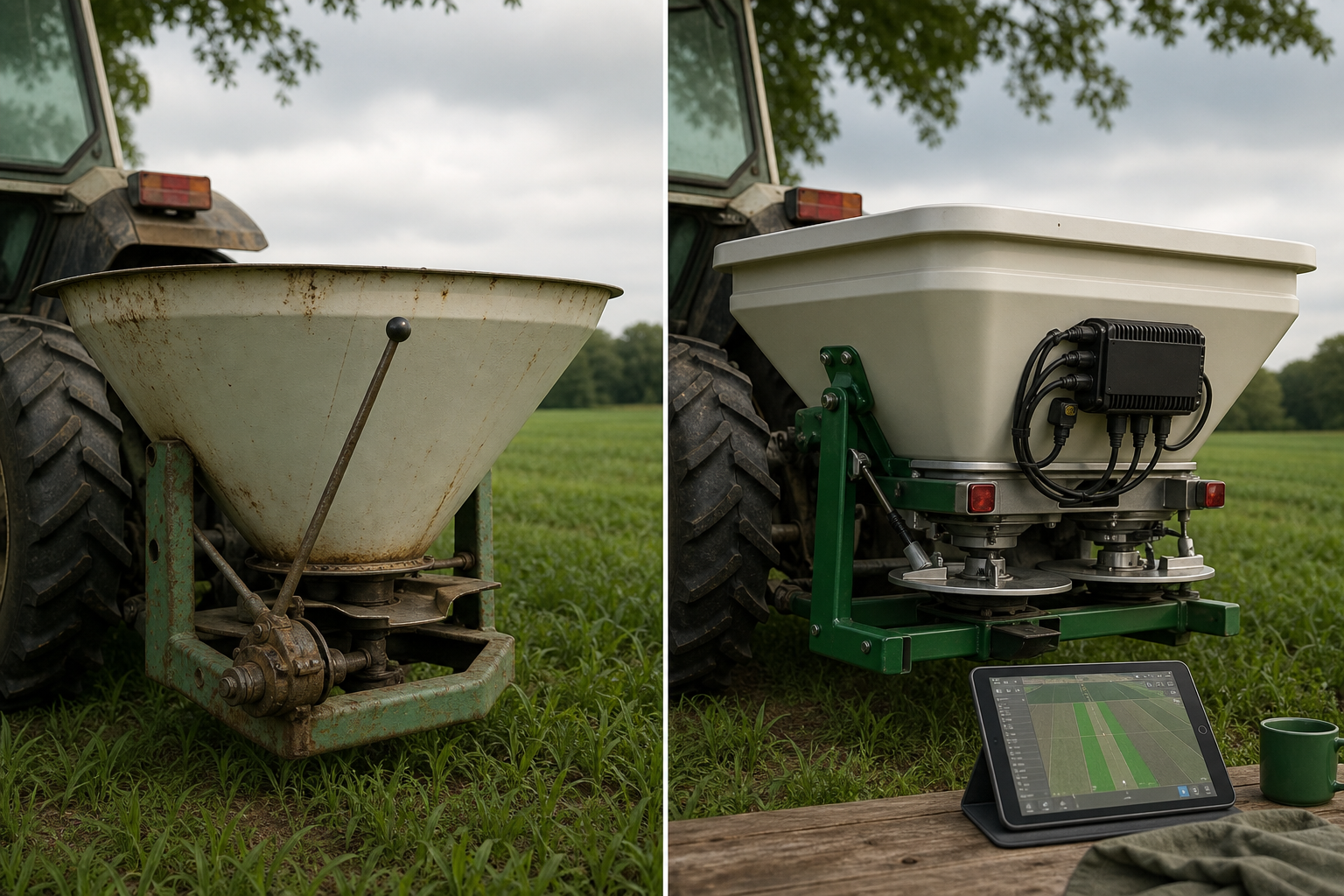
The retrofit math. AEF member surveys and farm machinery trade press indicate implements older than 15 years almost universally lack CAN or ISOBUS connectivity. Implements built in the last 5–7 years typically ship with ISOBUS-ready wiring and ECUs. The cost wall is steepest at the 10–15-year boundary — that is where retrofit harnesses, rate controllers, and section modules combine to approach the implement's market value. Kansas State machinery economics guides recommend the 50–60% threshold as the trigger to replace rather than retrofit. Below that threshold, retrofit usually wins on capital cost. Above it, the cost of integration starts eating the cost of a newer unit.
The crop-margin filter. Kansas State University Agricultural Economics work led by Dr. Terry Griffin finds that RTK autosteer payback typically lands in 1–3 years on 800–1,500-acre grain farms, with fuel savings of 2–6%. Implement upgrade payback follows a similar curve but is faster on high-value crops — vegetables, specialty grains, seed corn — where uneven application creates visible yield loss and quality penalties. It is slower on commodity crops in low-margin years where input savings compete against thin per-acre profit. Run the math on your specific rotation, not on a generalized payback chart.
The hidden cost of GPS magnifying mechanical error. Lowenberg-DeBoer and Erickson (2019, Setting the Record Straight on Precision Agriculture Adoption, in Applied Engineering in Agriculture) document cases where precision hardware was installed but never used beyond base guidance — turning expensive sprayers and spreaders into conventional tools wearing precision badges. The corollary applies directly to retrofit decisions: a worn boom, leaking valves, or out-of-spec metering rolls cannot be fixed by adding electronic controls on top of them. Mechanical condition is a prerequisite, not a parallel concern. Run a calibration baseline — tray test for spreaders per Teagasc and University of Missouri protocols, nozzle flow within ±5% per UNL spray calibration guides — before authorizing any retrofit purchase. If the mechanical baseline fails, the retrofit decision is already made: replace.
Precision ROI lives in the implement, not the cab. A mediocre implement with perfect guidance is still mediocre — just precisely so.
The decision logic at the end of this analysis is straightforward. Retrofit if the implement has a functioning mechanical baseline and existing CAN or ISOBUS connectivity. Replace if either is missing on an implement 10+ years old. New implements should be evaluated against the specification checklist in the final section — not on the dealer's feature sheet.
Building an AgOpenGPS-Compatible Attachment Stack
An open-platform guidance stack is only as open as the implements connected to it. AgOpenGPS — the open-source precision guidance platform underlying the Agro Navigator iOS app — communicates with implements through the same ISO 11783 (ISOBUS) and CAN bus standards used by proprietary OEM systems. The technical conformance is identical. The difference is in software licensing, data ownership, and the absence of a vendor's Virtual Terminal as a chokepoint between you and your machinery.
For farmers building this stack deliberately, three structural decisions matter.
Data ownership and portability. The American Farm Bureau Federation's Privacy and Security Principles for Farm Data warn that proprietary platforms can give OEMs broad rights over machine and agronomic data collected by implements. With AgOpenGPS-compatible hardware and a native iOS controller, the application maps, as-applied logs, and field boundaries remain on the operator's device or a server the operator controls. Switching implement brands does not orphan historical data — a constraint that closed-platform users face routinely when they trade equipment. Data continuity across machinery generations is a defensible long-term asset. Treat it that way.
Open Virtual Terminal logic. Jim Kolb at AEF has noted that ISOBUS was designed specifically to allow a single Virtual Terminal to control multiple brands of attachments. An iOS-based control surface — running on an iPad in-cab — extends this principle to a tablet form factor most operators already own. The implement's ISOBUS messages are interpreted by software the operator controls, not licensed from the implement OEM. Multi-brand fleets become operationally simpler, not harder, because the control surface stops fragmenting across vendors.
Future fleet coordination. Planned roadmap features like predefined path driving and multi-vehicle coordination depend on implement-level data flowing back through the guidance system to a fleet dashboard. With a 4G/GSM telemetry-equipped hardware tier, this data leaves the implement, passes through the iOS app, and arrives at a remote dashboard without going through a proprietary cloud. Implements selected today should not block tomorrow's fleet logic — meaning ISOBUS Task Controller conformance (TC-BAS, TC-SC, TC-GEO) matters more than brand alignment. The same principle scales to mixed terrain operations, including farming systems engineered for varied terrain where multiple machine types coordinate within a single management zone.
Practical implement candidates: ISOBUS-conformant sprayers from brands publishing AEF certification, granular spreaders with documented TC-GEO support, and electric-drive planters with per-row ECUs that expose population and downforce data via standard CAN messages. The AEF ISOBUS Database maintains a public registry of certified implements by function. Treat it as the first reference before any dealer conversation.
AgOpenGPS Implement Compatibility — 5-Point Verification
- AEF ISOBUS certification or documented community integration. Verify the implement appears in the AEF ISOBUS Database for TC-BAS, TC-SC, or TC-GEO functions, or has documented integration on AgOpenGPS community forums with screenshots of working configurations. Vendor claims of "ISOBUS-ready" without a certification level are marketing language.
- Standardized 9-pin ISOBUS connector and CAN bus access. No OEM-specific harness adapters. The implement should accept standard ISO 11783 connectors with no proprietary firmware handshake required to recognize a third-party Virtual Terminal. If the connector requires a specific OEM display to authenticate, it is not open.
- Exportable application logs and prescription map ingestion. The implement must accept ISO XML prescription maps (TC-GEO format) and export as-applied logs in the same format. No proprietary file formats that require dealer software for export or import. Format lock-in is data lock-in.
- Independent parts and service availability. Nozzles, sensors, valves, metering components, and ECUs must be sourceable without OEM dealership routing. Mechanical wear items should have aftermarket equivalents. Single-source supply chains create downtime risk during planting and spraying windows when delays are non-recoverable.
- Documented control unit and firmware update path. The implement's ECU should accept firmware updates without locking to a specific OEM cloud account. Community documentation on integration is a strong indicator of long-term compatibility. If firmware updates require a subscription, that subscription is part of the implement's true total cost.
Pre-Purchase Specification Checklist: What to Ask Before You Sign
This checklist is the deliverable. Print it. Take it to the dealer. Walk it line by line before any precision implement purchase, whether new, used, or retrofit. Each item maps to a documented failure mode — abandoned precision features, vendor lock-in, mechanical underperformance, or integration cost surprises. Items are ordered by purchase-decision priority, not by category.
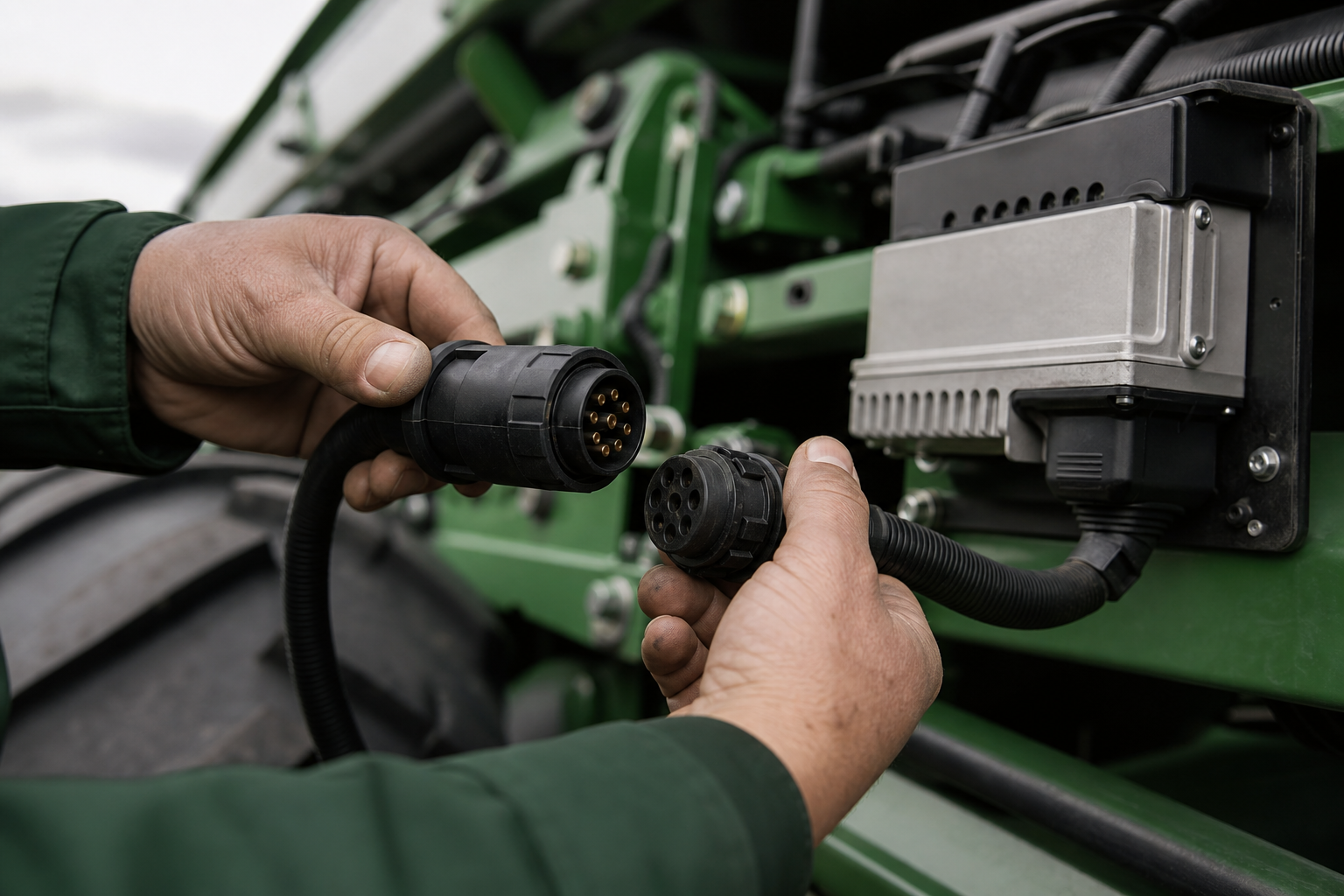
- ISOBUS / CAN bus conformance — verify the certificate. Demand the AEF ISOBUS certification level: TC-BAS for basic task control, TC-SC for section control, TC-GEO for geo-referenced variable rate, TIM for tractor-implement management. The certificate names which functions interoperate with third-party Virtual Terminals — including open-platform iOS-based guidance stacks. No certificate means no guarantee.
- Sensor specification and accuracy tolerance. Flow meters, pressure sensors, population counters, and downforce actuators each have published accuracy ranges. For sprayers, confirm flow regulation within ±5% per ISO 16122. For seeders, confirm singulation testing per ISO 7256 with documented results. Get the numbers in writing on the spec sheet, not in the brochure.
- Application map ingestion and as-applied log export format. Confirm the implement accepts ISO XML (TC-GEO) prescription maps and exports as-applied logs in ISO XML or shapefile format. Proprietary formats requiring dealer software for export should be a disqualifier. They create data lock-in regardless of which guidance brand you run in the cab.
- Mechanical baseline verification. Inspect or commission a calibration test before purchase: nozzle flow check on sprayers per UNL Extension protocol, tray test on spreaders for CV under 15% per Teagasc and University of Missouri protocols, seed meter test stand on planters. Mechanical condition gates electronic value. Electronics cannot fix a worn mechanism.
- Tractor hydraulic and electrical capacity match. ASABE equipment selection guidelines note ISOBUS implements may draw several amps per ECU; high-end planters with electric drives and downforce actuators can require 20–30 L/min hydraulic flow. Confirm your tractor meets specification before purchase. Older tractors may need upgrades that cost more than the implement features being chased.
- Independent parts and service supply chain. Identify three sources for wear parts — nozzles, meter components, sensors — before purchase. OEM-only parts pipelines create downtime risk during planting or spraying windows when a one-week delay loses a season's profitability on the affected acres. Single-source supply is a hidden cost line.
- Software update and firmware ownership. Ask explicitly: does the ECU require a dealer account to receive firmware updates? Does any feature unlock require ongoing subscription? Document the answers in writing. Subscription-gated rate control or section control is a recurring cost that changes ROI math significantly across a 10-year ownership horizon.
- Data ownership in the purchase contract. Read the data clauses. The operator should retain ownership of agronomic and machine data, with OEM rights to aggregate, resell, or restrict data access explicitly limited in writing. The American Farm Bureau Federation principles cited earlier provide the contract language baseline — bring it to the negotiation.
- Local service competence on open-platform integration. Confirm at least one local dealer or independent service tech has integrated this implement with a non-OEM guidance system. If the implement only works "supported" with one brand's display, it is not truly open regardless of certification claims. Field-level support competence is the difference between a working integration and a stranded asset.
- Future-fleet readiness. Will this implement need to talk to a second tractor, a fleet dashboard, or a remote monitoring system within five years? Implements selected today should expose application data via standard ISOBUS messages — not require proprietary fleet software to participate in coordination. With 4G/GSM telemetry hardware and planned multi-vehicle coordination already on credible open-platform roadmaps, ISOBUS Task Controller conformance is the gating spec for fleet participation, not an optional extra.
Asking whether an implement is RTK-ready is the wrong question. The right question is what data it produces and who owns it.
Run every implement — new, used, or retrofit candidate — against these ten questions. Tractor attachments that pass become precision multipliers on your RTK investment. Implements that fail are conventional tools wearing precision badges, and the ROI math will eventually expose them.