

7 Powerful Benefits of Terrace Farming for Modern Sustainable Agriculture
Table of Contents
- Why Hillside Farmers Abandon Marginal Land (And Why That Decision Costs More Than They Think)
- Soil Retention and Erosion Control — The Foundation Benefit
- Water Management and Drought Resilience on Sloped Ground
- Crop Yield Patterns and Biodiversity Gains by Crop Type
- The Honest Cost, Labor, and Payback Reality of Building Terraces
- Climate Resilience, Flood Mitigation, and the Emerging Carbon Question
- Choosing the Right Terrace Method for Your Slope, Soil, and Labor Budget
A grower owns 12 hectares of inherited hillside. The valley floor parcels nearby sell at three times the per-hectare price. Every spring storm carves new rills down the slope, and the topsoil that took centuries to build washes into the drainage ditch in three hours. The choice usually gets presented as binary: abandon the land, or plow it conventionally and watch fertility bleed out year after year.
There is a third option, practiced for over two thousand years on hillsides from the Andes to the Philippine Cordilleras, that converts the same liability into the most productive parcel on the farm. The catch is real. Upfront labor is significant, the payback window is measured in years rather than seasons, and method selection determines whether the investment compounds or collapses. What follows is a working analysis of the benefits of terrace farming — seven specific dividends, the conditions under which each materializes, what it costs to capture them, and a readiness checklist you can apply to your own slope by the end of the article.
Why Hillside Farmers Abandon Marginal Land (And Why That Decision Costs More Than They Think)
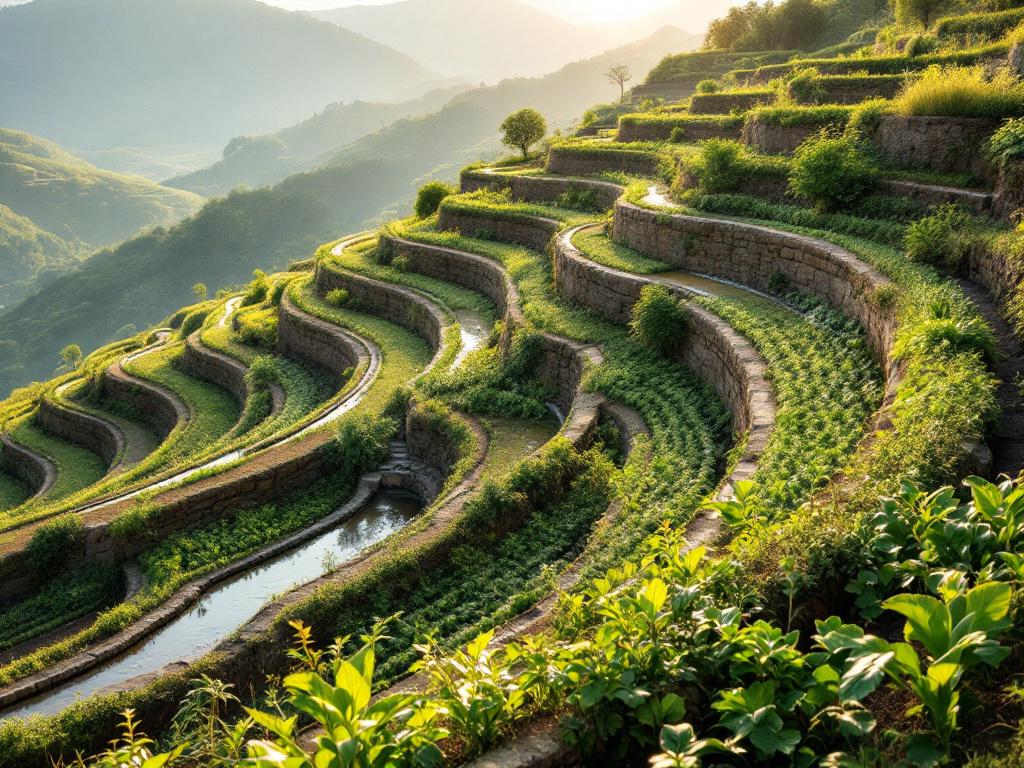
Steep terrain is genuinely harder to farm. Equipment rolls. Fuel burn rises because tractors fight gravity on every pass. Labor hours stretch. Erosion eats whatever yield the slope manages to produce. So most farmers do the rational thing on paper — they abandon marginal slopes, convert them to low-input pasture, or lease them out to neighbors who have nothing better to do with the acreage.
The math behind that decision deserves scrutiny. Doing nothing is not free. It has four hidden costs, and they compound.
Erosion-driven fertility loss. According to Purdue Extension AE-114, "terraces reduce both the amount and velocity of water moving across the soil surface, which greatly reduces soil erosion." Read the inverse: untreated cultivated slopes shed topsoil at rates that exceed the natural soil formation rate for most temperate soils, which is on the order of a single ton per hectare per year. Lose more than that for several consecutive years and you are mining the bank account that your future yields depend on.
Off-farm liability. Sediment runoff carries nutrients and agricultural chemicals into downstream waterways. In watersheds with Total Maximum Daily Load restrictions or equivalent agri-environment regulations, the farmer responsible for the upstream source is increasingly the farmer who pays for downstream remediation. This is regulatory exposure that did not exist a generation ago, and it does not get smaller over time.
Land value compression. Eroded slopes lose appraised value as productive topsoil thins. Regional appraisers commonly report that abandoned or heavily eroded hillsides trade at significant discounts to comparable arable land in the same county. The exact discount varies, but the direction does not — every season of unchecked erosion writes down the balance sheet value of the parcel.
Compounding opportunity cost. A hectare that produces nothing for 30 years while property taxes accrue is more expensive than a hectare that produces 60% of valley yields after a 5-year capital improvement. The do-nothing option only looks cheap if you ignore the time value of forgone output.
Terraces are not a conservation gesture. They are capital infrastructure that converts a depreciating slope into an appreciating asset, with the same logic as drainage tile in lowland fields.
Reframe the decision and the analysis changes. Terraces are not primarily a conservation virtue signal — they are economic recovery infrastructure. They sit in the same balance-sheet category as drainage tile in a wet bottom field or center-pivot irrigation on dryland. You spend capital to fix a productivity constraint, and the fix becomes part of the long-term value of the land. The same data-driven approach to farm productivity that makes variable-rate fertilizer or yield-zone mapping pencil on flat ground makes terrace construction pencil on steep ground — provided you pick the right method for the slope, the soil, and the crop.
The remainder of this article quantifies seven specific dividends that terrace systems pay: soil retention, water management, yield gains on the right crops, biodiversity spillovers, climate resilience, carbon and soil organic matter accumulation, and method flexibility for varying labor budgets. Each benefit has a condition. Each has a cost. The closing section gives you a checklist.
Soil Retention and Erosion Control — The Foundation Benefit
The mechanical explanation comes directly from Purdue Extension AE-114: terraces work by interrupting slope length and reducing the velocity of water moving across the soil surface. The detail that matters for the math is that erosive energy scales with the square of water velocity. Cut velocity in half and you cut roughly three-quarters of the erosive force. That is the underlying physics; everything else is engineering on top of it.
Three physical mechanisms do the actual work:
- Slope-length interruption — water cannot accelerate down a continuous gradient when a bench breaks the slope every few meters of vertical drop.
- Bench impoundment — flat or near-flat bench surfaces capture rainfall and hold it long enough for infiltration to occur instead of runoff.
- Channel redirection — designed grassed waterways or stone-lined channels move excess water laterally at velocities engineered to stay below the erosion threshold.
The ranges in the table below reflect qualitative outcomes commonly reported in extension literature on terraced versus untreated slopes of comparable angle. They are directional, not a single sourced statistic.
| Metric | Untreated Cultivated Slope (10–25°) | Terraced System (same slope) | Mechanism |
|---|---|---|---|
| Surface water velocity | High; accelerates with slope length | Reduced; interrupted at each bench | Slope-length interruption |
| Erosion risk class | High to severe | Low to moderate | Velocity reduction |
| Water infiltration | Limited; most rainfall sheds | Substantially increased; benches pond water | Bench impoundment |
| Topsoil retention over 10 years | Continuous net loss | Net stable or accumulating | Combined effects |
| Nutrient export to waterways | High | Reduced | Sediment trapping |
The row that matters most economically is the third-from-bottom one. Topsoil retention compounds. A single severe storm event on an untreated slope can erase decades of organic matter accumulation, and three or four severe events over a decade can take the soil profile down to subsoil or parent material on the most exposed contours. Once you reach that point, the slope is no longer producing — it is just hosting weeds.
The secondary effect strengthens the case. As benches retain soil over time, organic matter accumulates because biomass is not being flushed off the surface every spring. Higher organic matter raises cation exchange capacity and water-holding capacity, which in turn raises fertilizer efficiency and drought tolerance. The benefit compounds in the same way that a no-till field improves year over year — slowly, then noticeably.
There is an honest caveat worth surfacing. According to Geopard — an agricultural-technology vendor whose blog discusses terrace systems — poorly designed terraces can disrupt natural hydrological flow and locally degrade soil if drainage is mismanaged. The point cuts both ways: design quality determines outcome. A terrace that ponds water where it should drain or drains water where it should infiltrate produces worse results than the untreated slope. The mechanism is not magic; the engineering has to be right.
Water Management and Drought Resilience on Sloped Ground
The counterintuitive insight about terraces is that they help in both droughts and floods, because they solve the same underlying problem from opposite directions: keeping water in contact with soil long enough to be useful.
The five-step retention mechanism works as follows.
Step 1: Interception. Rainfall hits the terrace bench instead of accelerating down an unbroken slope. Most well-designed benches have a slight inward slope of 2–5° directing water toward the back of the bench or into a designed channel rather than spilling over the front edge.
Step 2: Ponding. Water collects briefly on the bench surface. On an untreated slope of comparable angle, the contact time between water and soil is measured in seconds before runoff carries the water downhill. On a well-designed bench, that contact time stretches to minutes during light rain and potentially hours during sustained events.
Step 3: Infiltration. Extended contact time allows water to move through the soil profile rather than running off the surface. This is the mechanism that simultaneously addresses drought (more soil moisture stored in the root zone for later use) and flood (less downstream runoff surge during the event itself).
Step 4: Lateral redistribution. Excess water that exceeds bench capacity moves through grassed waterways or stone-lined channels at engineered velocities low enough to avoid erosion. Purdue Extension AE-114 discusses parallel terrace systems where waterway design is integrated with bench layout to handle equipment passes and water management together.
Step 5: Deep storage. Water that infiltrates past the active root zone recharges shallow aquifers and supports baseflow in nearby streams during dry periods. This watershed-level benefit has begun attracting payment-for-ecosystem-services funding in some regions, though the policy framework remains uneven globally.

A terraced slope does not just hold more water. It holds water where roots can reach it. In drought years, that difference is the margin between harvest and failure.
The drought scenario plays out as follows. In a season with 30% below-average rainfall, a terraced plot typically maintains crop growth because the rainfall that did fall was captured in the soil profile rather than shed downhill. The same crop on an untreated slope of comparable angle suffers earlier and more severely because each rainfall event delivered less effective moisture to the root zone. The benefit is largest on slopes between roughly 8° and 25°, where untreated runoff fractions are highest.
The flood scenario plays out in the opposite direction but uses the same infrastructure. Terraces absorb the first portion of an intense rainfall event before any meaningful runoff reaches downstream channels. The peak flow downstream is reduced because the upstream landscape is acting as distributed detention storage. This protects downstream fields, roads, and culverts — not just the terraced parcel itself.
The honest limitation is that very intense events, on the order of 100mm/hour or greater, can overtop poorly designed benches and cause catastrophic failure if the engineered waterways were sized for ordinary storms. Field-scale water variability matters here, and operators using real-time GPS field data to map saturation patterns and runoff paths during normal rainfall events can identify weak points in the terrace system before the storm that breaks them.
Crop Yield Patterns and Biodiversity Gains by Crop Type
"Terrace farming increases yields" is a vague claim worth disaggregating. The honest picture is that yield response varies dramatically by crop, and the return-on-investment window is much shorter for some crops than others. The mistake most overviews make is averaging a wine-grape vineyard with a wheat field and reporting a single number.
Two variables drive the ROI math:
- Is the crop perennial or annual? Perennials amortize terrace construction over decades of harvest cycles. Annual crops have to justify the same capital cost against shorter planning horizons.
- Does the crop carry a quality premium? Slope-grown wine grapes, tea, coffee, and olives often command quality premiums that flat-grown equivalents do not. When quality grades scale revenue more than yield, terraced microclimates can outperform flat ground on dollar-per-hectare terms even at equal tonnage.
The matrix below reflects general agronomic consensus rather than a single sourced study. ROI windows are illustrative ranges, not contractual estimates.
| Crop Category | Examples | Typical Yield Pattern | ROI Window | Best Fit? |
|---|---|---|---|---|
| Premium perennials | Wine grapes, tea, coffee, olives | Quality premium plus steady yield | ~5–8 years | Strongest case |
| Tree fruit and nuts | Apples, almonds, citrus | Comparable per-tree yield to flat | ~6–10 years | Strong if access designed in |
| Annual vegetables | Tomatoes, peppers, leafy greens | High value-per-hectare offsets labor | ~3–5 years | Good with irrigation |
| Grains and pulses | Wheat, barley, lentils | Lower margin per hectare | ~8–12+ years | Marginal case |
| Cover crops and forage | Clover, vetch, perennial grasses | Soil-building role | Indirect | Yes as rotation component |
Why perennials win the math. A vineyard or coffee plot with a 30-year productive life amortizes terrace construction across 30 years of revenue. Annual crops cannot match that depreciation horizon, so the per-year construction-cost burden is higher and the crop has to produce a higher gross margin to compensate. For grains in particular, terracing rarely pencils unless the slope is otherwise unfarmable — in which case the comparison is not "terrace versus flat" but "terrace versus abandon," and the math swings back in favor of construction.
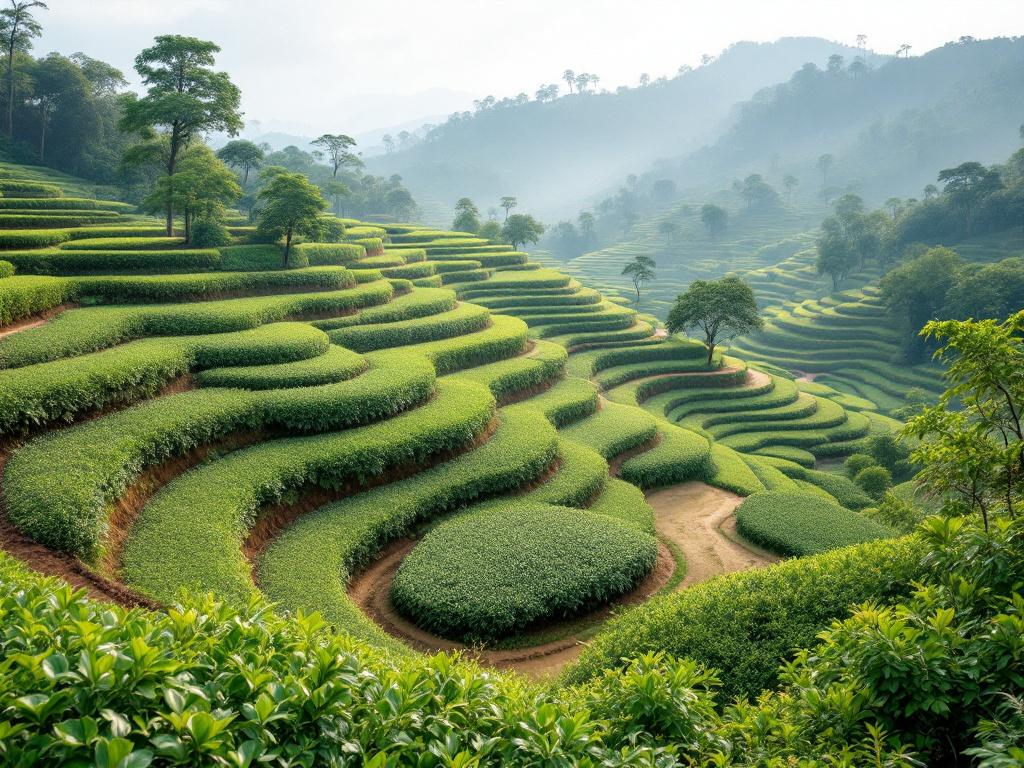
The microclimate dividend. Established terraces, particularly stone-faced ones, create thermal mass that buffers temperature swings and extends growing seasons modestly. Stone retains daytime heat and releases it slowly overnight, which matters for frost-sensitive crops on the margin of their geographic range. For quality-graded crops like specialty coffee and wine grapes, slope aspect and bench microclimate can produce measurable quality improvements — and quality grade differences often dwarf yield differences in revenue per hectare. This is the same logic that drives premium vineyard siting on sloped ground in Burgundy, Mosel, and Mendoza. The terrace is not just retaining soil; it is producing a measurably different crop. Operators integrating next-generation farm technology overlays for canopy management and ripeness mapping can quantify these microclimate effects bench by bench rather than treating the whole hillside as one block.
The biodiversity spillover. Terraced systems with stone retaining walls, grassed waterways, and varied bench widths host more habitat heterogeneity than uniform flat fields. Stone walls shelter beneficial insects, reptiles, and small mammals. Grassed waterways support pollinator forage. The result is documented in agroecology literature as higher densities of beneficial insects — both pollinators and predators of crop pests — and richer soil biology under terraced canopy. The economic translation is lower pesticide use and more consistent fruit set on insect-pollinated crops. The benefit is real but distributed across many small effects rather than concentrated in a single line item.
The honest tradeoff. Higher labor intensity, especially for annual crops where every cultivation, weeding, and harvest pass must respect bench geometry. Mechanization is possible on well-designed terraces but requires equipment matched to bench width and turning radius. If the operator already owns equipment sized for valley fields, the terrace design either accommodates that equipment or forces a labor reversion.
The Honest Cost, Labor, and Payback Reality of Building Terraces
Terraces are not a quick fix, and any source presenting them as low-effort is selling something. The numbers below are framed as regional planning ranges, not quotes.
Initial earthwork and construction cost. Construction cost varies dramatically by method, region, and labor rates. Stone bench terraces requiring skilled masonry sit at the high end of the spectrum and can take years to complete on a per-hectare basis when done with traditional methods. Earth contour bunds requiring only basic earth-moving equipment sit at the low end and can be built in weeks. Hybrid systems combining earth construction with stone facing or vegetative reinforcement fall in between. The cost composition shifts by region — labor dominates in low-wage regions, equipment time dominates in mechanized regions. Treat any single quoted figure with suspicion until you have at least two competing local estimates.
Payback timeline. Realistic timelines to recover construction investment fall into three bands. High-value annual crops with irrigation access typically pay back in roughly 3–5 years. Premium perennials like wine grapes or specialty coffee typically pay back in roughly 5–8 years. Grains and broad-acre field crops can require 8–12 years or longer, and often only pencil when the avoided-cost component is properly counted. Payback math should include both direct yield revenue and avoided erosion costs — the topsoil you did not lose, the productivity decline you did not suffer, the regulatory fines you did not pay. Many farmers under-count the avoided-cost component because it does not appear on an invoice.
The payoff arrives in year five, not year one. Anyone selling terraces as a short-term yield boost is selling the wrong product.
Annual maintenance labor. Ongoing labor includes inspecting and repairing bench edges after major rain events, clearing drainage channels, managing vegetation on waterways, and periodically rebuilding stone walls or earth bunds. Earth bunds require the most frequent rebuilding because rain and traffic gradually flatten them. Stone benches require the least frequent maintenance but the most skilled labor when intervention is needed. Plan for maintenance as a recurring annual line item, not a one-time event. Operators who treat terraces as "build and forget" infrastructure typically watch their system degrade noticeably within a decade.
Equipment access and mechanization. Whether terraces help or hurt mechanization depends entirely on design intent. Parallel terraces designed to multiples of equipment working width preserve full mechanization, as documented in Purdue Extension AE-114, which emphasizes spacing aligned to planting and harvesting equipment widths. Narrow benches designed without equipment in mind force a reversion to manual labor for every operation — which may be fine for a high-value vegetable plot but kills the economics of a grain rotation.
Financing and incentive programs. Many regions have soil and water conservation programs that co-finance terrace construction. USDA EQIP (Environmental Quality Incentives Program) in the United States, equivalent agri-environment schemes in the EU Common Agricultural Policy framework, and watershed restoration funds in developing economies all touch terraces under various headings. Carbon markets are an emerging but still immature funding source for soil-conservation infrastructure. Treat all of these as worth investigating with local extension agents before construction begins, rather than as guaranteed offsets to capital cost.
The decision filter. Terrace construction makes sense when four conditions hold: the slope is otherwise unfarmable or seriously erodible; the planned crop justifies the amortization window; labor or financing is available at planning rates; and the operator has a planning horizon of at least 10 years on the parcel. If any one of these is missing, alternatives — contour cropping, agroforestry, conversion to perennial pasture, or simple permanent retirement under a conservation easement — may produce better risk-adjusted returns. The point is not that terraces always pencil. The point is that when they pencil, they pencil for decades.
Climate Resilience, Flood Mitigation, and the Emerging Carbon Question
Three climate-era functions have moved terraces from a heritage practice to a strategic asset in the past two decades. None of the three is new to the engineering, but all three are newly valuable.
Flood pulse moderation. As rainfall events become more intense in many regions — a trend documented broadly in IPCC assessment cycles — the capacity of a landscape to absorb peak rainfall determines downstream damage. Terraces function as distributed micro-detention basins. A hillside of well-designed terraces can absorb a meaningful fraction of a high-intensity rainfall event before any runoff reaches downstream channels, reducing peak flow and the cascading damage to roads, culverts, and lowland fields. Watershed-management literature documents this effect at the small-catchment scale. The headline implication is that terraces produce a public good — downstream flood reduction — that the terrace operator does not capture on their own balance sheet. That gap between private and public value is the policy opening that watershed payment programs are now starting to fill.
Drought buffer. The mechanical case was made in the water-management section. The climate-framed version is that regions experiencing increasing variability — wetter wet seasons and drier dry seasons in the same calendar year — benefit doubly from terraces. The same infrastructure that absorbs intense rainfall releases that water slowly into soil moisture and shallow aquifers during the following dry period. In climate regimes shifting toward higher variability rather than uniform aridity or uniform wetness, this two-sided buffering is more valuable than either function alone.
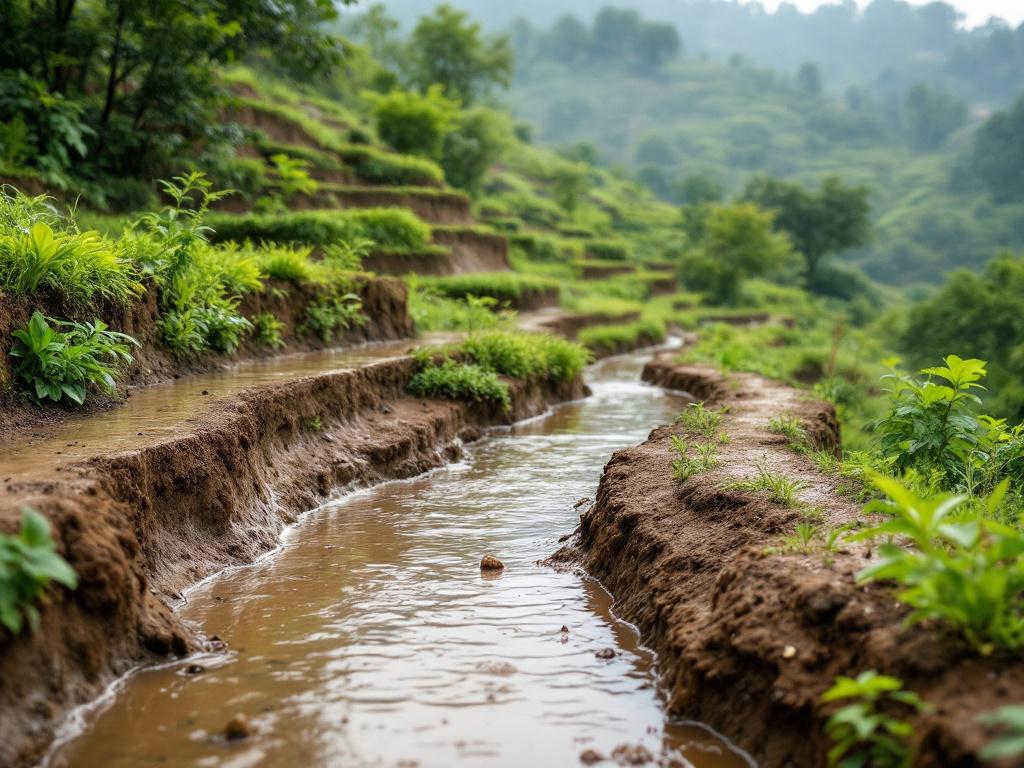
Carbon and soil organic matter accumulation. This is the most-hyped and least-quantified benefit in current discourse, so it deserves an honest framing. Terraced systems, by retaining topsoil and supporting more standing biomass over time than equivalent eroding slopes, do accumulate soil organic carbon at higher rates. The magnitude is modest on a per-hectare per-year basis, and converting that accumulation into tradeable carbon credits requires measurement, reporting, and verification protocols that most smallholders cannot afford under current market structures. The honest position is that soil organic matter accumulation is a real co-benefit that improves the agronomic performance of the soil over time. Treating it as an active revenue line from carbon markets is premature for most operators in most regions today.
Funding mechanisms separate cleanly into three categories by maturity:
- Active now: Watershed protection payments — New York City's long-running Catskill watershed payments to upstream landowners are the canonical precedent — plus national conservation cost-share programs and EU agri-environment schemes.
- Emerging: Voluntary carbon market credits for soil organic carbon accumulation, ESG-linked agricultural lending with preferential rates for conservation infrastructure, and premium pricing for regeneratively-grown produce with verifiable origin.
- Speculative: Direct climate adaptation grants from international funds reaching individual farmers, large-scale ecosystem services markets with liquid pricing, and integration of terrace infrastructure into crop insurance discounts.
The critical caveat surfaces here again. Geopard's vendor blog notes — and the point deserves weight even from a promotional source — that terrace construction can disrupt local hydrological cycles when poorly executed. Reframed honestly, terraces are landscape engineering, and like any landscape engineering, bad design produces unintended consequences. Springs can shift. Downstream baseflow patterns can change. Slope stability can be undermined if benches are cut without adequate drainage behind them. The climate benefit case rests on design quality, not on the existence of terraces in the abstract.
The climate resilience argument is strongest for landowners with a multi-decade planning horizon. For an operator planning to sell or transition the land within five years, much of the climate dividend will materialize on the next owner's balance sheet rather than their own — but increasingly, that future value is being priced into land transactions in climate-exposed regions. A documented, well-maintained terrace system on a sale parcel commands a premium that an eroded equivalent slope does not. The investment shows up in the sale price even when it has not yet shown up in the cash-flow statement.
Choosing the Right Terrace Method for Your Slope, Soil, and Labor Budget
The terrace method you build determines whether the investment from the previous sections compounds or collapses. Four main methods cover most of the field, drawn from the categorizations in Purdue Extension AE-114 and the broader bench-versus-contour distinctions discussed in the Geopard vendor overview.
| Method | What It Is | Best Slope Range | Soil Suitability | Lifespan / Labor |
|---|---|---|---|---|
| Bench terrace (stone-faced) | Level benches with stone retaining walls | Steep (15–40°) | Clay, loam, rocky | Multi-decade; high initial, low ongoing |
| Earth contour bund | Soil ridges along contour, sloped between | Gentle to moderate (5–20°) | Most non-sandy soils | Shorter; needs rebuild; moderate labor |
| Stone line / rock bund | Permeable rock lines along contour | Moderate (10–25°) | Rocky, shallow soils | Multi-decade; low initial, low ongoing |
| Hybrid (earth + stone + vegetated) | Earth structure faced with stone or reinforced with deep roots | Moderate to steep (15–35°) | Mixed | Multi-decade with maintenance |

The decision logic walks through five layered filters.
Start with slope angle. Above roughly 30°, only bench terraces with strong retaining structures are stable over decades. Earth bunds on those grades will eventually slump or breach. Below roughly 10°, full bench construction is overkill — contour cropping, strip cropping, or simple bunds usually accomplish the conservation goal at a fraction of the cost. The middle range from 10° to 30° is where method choice matters most, and where soil and crop considerations break the tie.
Then consider soil. Sandy soils require vegetative reinforcement because they will not hold a vertical or near-vertical face under their own structure. Clay soils hold structure but can crack and slump if drainage behind the bench is poor — clay terraces need engineered drainage as much as they need wall strength. Rocky shallow soils favor stone-line methods that work with the existing geology rather than against it, and they have the side benefit of converting field clearance work into construction material.
Then consider labor and capital. Stone bench terraces historically were built either by skilled paid masons or by generations of accumulated household labor — the pattern that produced the terraces of the Philippine Cordilleras, the Peruvian Andes, and the Mediterranean hillsides. Modern operators rarely have access to the second category, which leaves contracted skilled labor as the practical option. Earth bunds can be built faster with basic earth-moving equipment but require ongoing rebuild every few years. Hybrid methods split the difference and can be staged over multiple seasons.
Then consider the crop. Wide benches for mechanized perennials require different geometry than narrow benches for hand-tended vegetables. The Purdue parallel-terrace concept of designing bench spacing to multiples of equipment working width matters here — getting it wrong locks you into either replacing equipment or replacing terraces, and both are expensive.
Finally, decide DIY versus contractor. Earth bunds are within reach of many farm operators with basic earth-moving capability and a willingness to learn contour layout. Stone construction generally requires specialized skill and is better contracted to crews with portfolio examples you can inspect. Vegetative reinforcement work — establishing deep-rooted species like vetiver grass or similar — is usually a DIY operation but takes 2–3 seasons to fully establish before the reinforcement is mechanically meaningful.
Terrace Farming Readiness Checklist
- Map slope angles. Use a smartphone inclinometer app or hand-held clinometer. Record the steepest, gentlest, and average slope across the proposed area. Walk the contour, not just the fall line.
- Identify soil type and depth. Conduct a basic soil test or consult a local extension office. Note any rocky outcrops, shallow soil zones, springs, seeps, or persistent wet spots that will affect drainage design.
- Confirm crop intent. Specify the crop or rotation you plan to grow, and verify it pencils against the amortization window for the method you are considering. If the crop and the method give you a 12-year ROI window and you have an 8-year planning horizon, the math does not work.
- Survey financing and incentive options. Contact local conservation programs, watershed authorities, or agri-environment schemes. Document any cost-share rates available before you commit to a budget.
- Choose DIY, contractor, or hybrid construction. Get at least two quotes if contracting. Inspect a portfolio of completed work that is at least five years old — fresh terraces look fine; aged ones reveal whether the contractor's drainage design held up.
- Commit to a maintenance plan. Identify who will inspect benches after heavy rain, clear waterways annually, and rebuild bunds as needed. Maintenance neglect kills more terrace systems than any single storm event.
- Set a realistic ROI horizon. Plan against the timelines from the cost section: roughly 3–5 years for irrigated annuals, roughly 5–8 years for premium perennials, longer for grains. Build the cash-flow projection before you build the terrace.
The 12-hectare hillside that opened this article — the one selling at a third the price of the valley floor parcels — is the same physical asset whether you abandon it or build it. The difference between the two outcomes is roughly five years of disciplined capital work and ongoing maintenance. The hillside that was sitting idle becomes the parcel with the longest productive horizon on the farm.